2
4

2
Stillinger
4
Klimakalender
Terje Osmundsen
Terje Osmundsen
Grunnlegger og adm. dir. Empower New Energy. Investor og styremedlem innen fornybar energi.
Publisert 22. mars 2015
Sist oppdatert 25.03.2022, 09:55
Artikkelen er mer enn to år gammel
Debatt

What’s the cost of greening Africa’s power sector?

McKinsey on Africa power sector: With 150 billion US dollars, CO₂ emissions can be cut one third by 2040.
Publisert 22. mars 2015
Sist oppdatert 25.03.2022, 09:55
Artikkelen er mer enn to år gammel
Terje Osmundsen
Terje Osmundsen
Grunnlegger og adm. dir. Empower New Energy. Investor og styremedlem innen fornybar energi.

McKinsey recently published a study on the growth potential of the sub-Saharan electricity sector, "Brigther Africa". The study projects that sub-Saharan Africa will consume nearly 1,600 terawatt hours by 2040, four times what was used in 2010.

By 2040, sub-Saharan Africa will consume as much electricity as India and Latin America combined did in 2010, but 20-30 percent of the continent's population will still not have access to electricity.

McKinsey estimates that if every country carry out the most cost-effective expansion of their power sector, the investments needed to 2040 would be $490 billion of capital for new generating capacity, plus another $345 billion for transmission and distribution.

In this Reference scenario, the share of natural gas in power generation increases from 6 to 44 % in 2040, at the expense of coal that drops from 51 to 23 % in terms of marketshare, see Exhibit C.
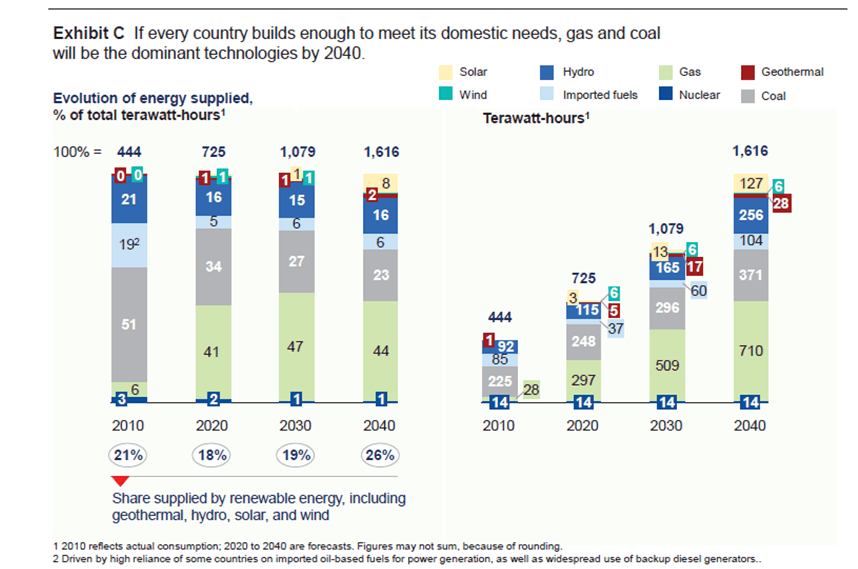
Source: McKinsey "Brighter Africa", February 2015

McKinsey also submitted an alternative scenario called the High-renewables case, marked by a significantly faster expansion of wind and particularly solar PV. If sub-Saharan Africa aggressively promotes renewables, it would obtain a 27 percent reduction in CO₂ emissions from power generation. However, the consultants estimate that this "green scenario" would require additional capital spending of about $150 billion, or 18 percent more capital spending than in the Reference scenario.
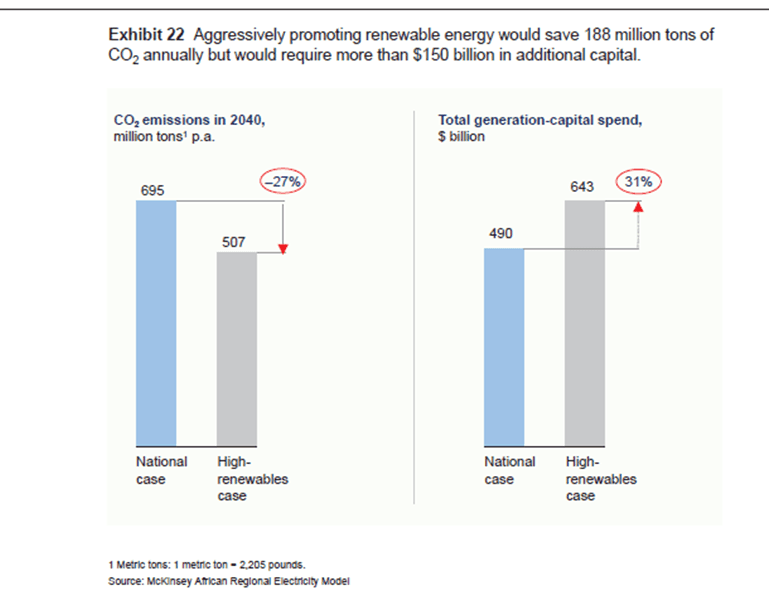
Source: McKinsey "Brighter Africa", February 2015

As McKinsey recognise, a strong push for solar and wind would not only lead to less emissions, but also reduced long-term fuel cost. In addition, solar PV also has the advantage that installations can be ramped up rapidly to meet the growing power demand. No other source of electricity has this flexibility.

The McKinsey study highlights the importance of the ongoing discussions on improved climate finance to "bridge" the financing required to enable the realization of the high-renewable scenario. In addition to strengthening the financing mechanisms at the UN level (Green Fund, "CDM+", a.o), national development banks and export credit agencies can play a vital role in this area, as is currently being discussed in Norway. (See article (in Norwegian)).

The potential can be illustrated by an example: If for example the Norwegian Export Credit Guarantee Agency (GIEK) were enabled to underwrite the financing of hydropower, solar and wind parks in Sub-Saharan Africa countries with an exposure of up to say 50 Billion NOK, this could lead to more than 100 Billion NOK in total additional investments in renewables in less developed countries. Such financing could again result in an additional generation capacity of 8-10 GW. And because the new renewable power mainly would replace fossil fuels, the result would be annual reductions of CO₂ in the range of 7-8 million tons CO₂.

The main challenge facing developing nations is the competition for scarce funds and government guarantees. Therefore, capital-intensive investments in low-carbon energy tend not to be prioritized when competing with needs that are more urgent. On the road to a global climate deal in Paris later this year, rich countries should be called upon to extend guarantees or introduce other forms of risk-sharing with privately financed renewable energy providers investing in long-term renewable energy projects in developing countries.

ANNONSE
Bluesky

Les også

To menn i dress sitter og snakker i et utsmykket rom med gulldekorasjoner og en byste på en kappe i bakgrunnen. Den ene mannen gestikulerer, mens den andre sitter med hendene foldet.

Trump stansa IMO – no må Noreg og Europa vakne

Me var for naive. Det er kjensla eg står igjen med etter å ha vitna med eigne auge at USA og Donald Trump klarte å utsetje klimasatsinga i skipsfarten, skriv Reber Iversen frå Maritime CleanTech.
6. november 2025
Les mer

Om oss

Om oss
Våre støttespillere
Støtt vårt arbeid
Annonsere
Personvernerklæring
Administrer informasjonskapsler

Følg oss

Facebook
Bluesky
Linkedin
Rss feed

Kontakt oss

Redaksjonen
Energi og Klima
Odd Frantzens plass 5
N-5008 Bergen
til toppen
Støtt oss
Støtt oss
Artikkelen fortsetter under annonsen
Annonse
Våre støttespillere
Ledige stillinger i det grønne skiftet

NVE søker rådgiver

Rådgiver innen energibruk, dataforvaltning og digitalisering
Oslo, Trondheim, Tønsberg
Frist: 17.03.2026
Tre kollegaer som prater sammen rundt et bord

NVE søker rådgiver

Rådgiver innen EU-regelverk, energieffektive produkter og fornybar energi
Oslo, Trondheim
Frist: 11.03.2026
kaffepause kontor kollegaer