1

Støtt oss
Stillinger
1
Klimakalender

Om oss

Om oss
Støtt vårt arbeid
Annonsere
Personvernerklæring
Administrer informasjonskapsler

Følg oss

Facebook
Bluesky
Linkedin
Rss feed

Kontakt oss

Redaksjonen
Energi og Klima
Odd Frantzens plass 5
N-5008 Bergen
til toppen
Glen Peters
Glen Peters
Senior Researcher at CICERO. Research on human drivers of global change, global carbon cycle, bioenergy, scenarios, sustainable consumption, international trade and climate policy, emission metrics, and too much more.
Publisert 23. oktober 2017
Artikkelen ble først publisert on the Cicero website October 19, 2017.
Artikkelen er mer enn to år gammel
Articles in English

A forecast of the energy tran­sition to 2050

DNV GL has added a new addition to the energy outlook literature, one that builds a forecast of the ‘most likely’ future leading to around 2.5°C in 2100.

dnvgl1

Keeping global warming below 2°C is not likely based on current emission pledges. Investors should consider various scenarios, including scenarios leading to high-end catastrophic changes and low-end scenarios requiring ambitious policies and high transitional risk.

Publisert 23. oktober 2017
Sist oppdatert 15.9.2025, 23:30
Artikkelen ble først publisert on the Cicero website October 19, 2017.
Artikkelen er mer enn to år gammel
Glen Peters
Glen Peters
Senior Researcher at CICERO. Research on human drivers of global change, global carbon cycle, bioenergy, scenarios, sustainable consumption, international trade and climate policy, emission metrics, and too much more.

In early September DNV GL launched its Energy Transition Outlook (ETO), a global and regional forecast of the energy transition to 2050.

Do we need another energy outlook?

We have two outlooks from the International Energy Agency, the Energy Technology Perspectives and the World Energy Outlook. Most oil companies produce energy outlooks, including the Statoil Energy Perspectives. The Intergovernmental Panel on Climate Change (IPCC) performs an assessment, every five years or so, on the Mitigation of Climate Change including analysis of emission scenarios. Many more exist.

The DNV GL outlook is a bit different to the others, it is a forecast and not a scenario.

Energy outlooks are generally based on scenarios. Since the future is highly uncertain, scenarios are used to explore the consequences of these future uncertainties. Essentially, scenarios are used to explore how the global energy system may develop under a set of assumed and stylised future worlds.

The DNV GL energy transition outlook is a forecast, a prediction of the future. Essentially, they take a stance on where the world is going.

QUOTE: «Our intention, from the outset, has been to construct what we in DNV GL see as ‘a most likely future’ for energy through to 2050.»

Artikkelen fortsetter under annonsen

To cut to the chase, the DNV GL energy transition outlook ends with a world that burns enough coal, oil, and gas leading to about 2.5°C at the end of the century.

DNV GL still «strongly supports the Paris Agreement«, implying they want the world to be «well below 2°C«.

Why would they want to look at an outlook for a 2.5°C world?

In a risk setting, I would argue it is necessary to know where the world is going. The risk (and opportunity) for incumbents is to deviate from the expected path. To use a common example, if the world moves faster towards climate action, then there is a risk of stranded assets and opportunities in renewable energy technologies.

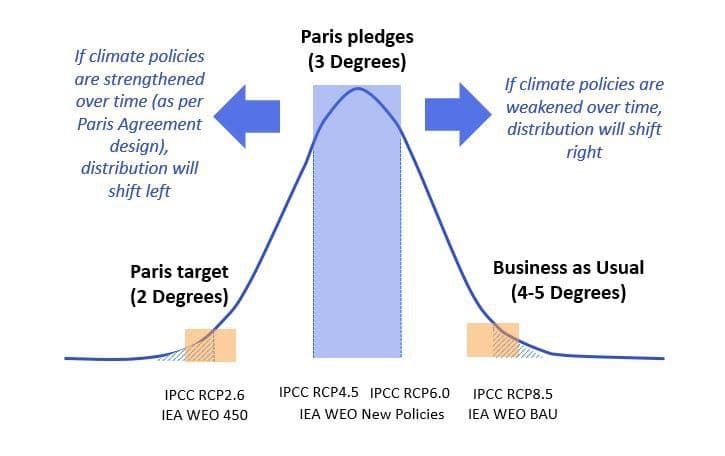
CICERO Climate Finance has used a similar framing. Financial risk associated with climate impacts or rapid societal transitions lies in the tails of the probability distribution, moving away from where current investments lie, thereby exposing financial and physical assets. The opportunities also lie in the tails, investing early before the transition is made.
Våre støttespillere

The use of a single forecast in the DNV GL energy transition outlook does not allow the opportunities and challenges of a more rapid transition (e.g., 2°C), or of a slower transition (e.g., 3°C), to be quantified. That would require additional analysis.

Keeping global warming below 2°C is not likely based on current emission pledges. Investors should consider various scenarios, including scenarios leading to high-end catastrophic changes and low-end scenarios requiring ambitious policies and high transitional risk.

Key points from the DNV GL Energy Transition Outlook

Making a forecast of the future is much harder than doing scenarios. Anyone can justify choices they make with scenarios, they are just to explore uncertainties, but forecasts require thinking things through more carefully.

DNV GL, for example, does not use population projections from the United Nations, but uses an alternative dataset which considers how urbanisation and rising education levels are linked to declining fertility. Their forecasted 2050 population of 9.2 billion people, is 6% lower than the United Nations median forecasts.

DNV GL also sees a slowdown in productivity growth as the world becomes more prosperous, which ultimately leads to slowing economic growth. The economy still grows, just not as fast as some others may assume.

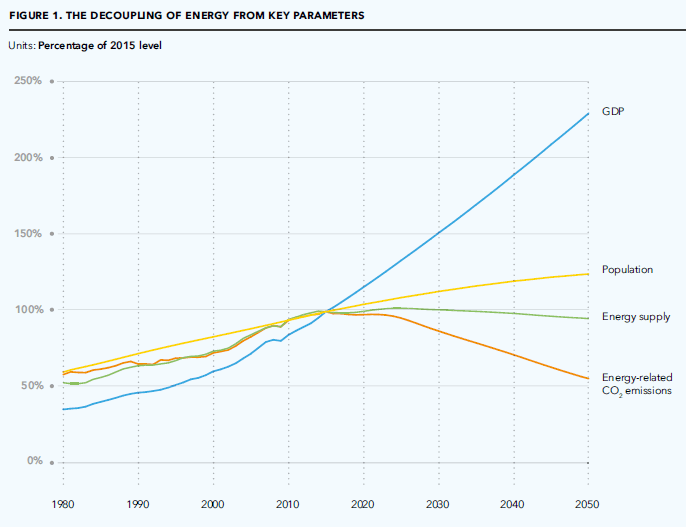
Globally average energy intensity, a measure of how much energy is used per unit economic output, has declined at 1.4% per year in the last 20 years. This relative decoupling is a feature of economic growth and productivity improvements, but DNV GL sees the declines increasing to 2.5% per year to 2050.

The slower population growth, slower economic growth, and stronger declines in energy intensity leads to flattening in energy demand after 2030, and due to a shift to renewable energy sources, a drop in CO2 emissions.

While not enough to keep below 2°C, these are still fundamental and unprecedented changes to the global energy system.

The trends in key variables explaining CO₂ emissions, measured relative to 2015 levels. DNV GL see a break in historic trends, particularly in the growth in energy supply and demand and CO₂ emissions.

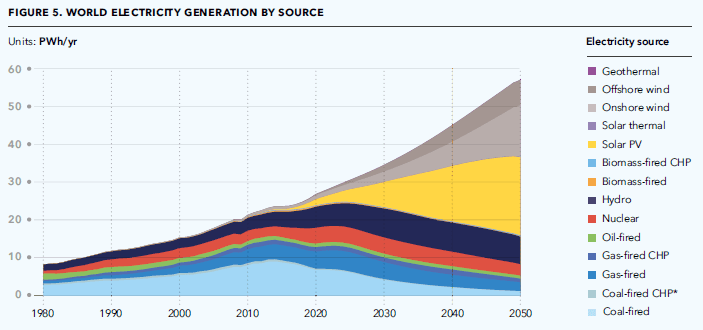
DNV GL sees some rather dramatic shifts in electricity generation, driven primarily by competition on price. Solar and wind both grow rapidly to have a 36% share each of electricity generation in 2050, 72% combined. When adding the contribution from hydro and nuclear, non-fossil energy sources dominate electricity generation in 2050, a significant contrast from today’s dominance of coal and gas.

Electricity generation by source through to 2050. DNV GL see a big shift to wind and solar power and rapid declines in coal generation.

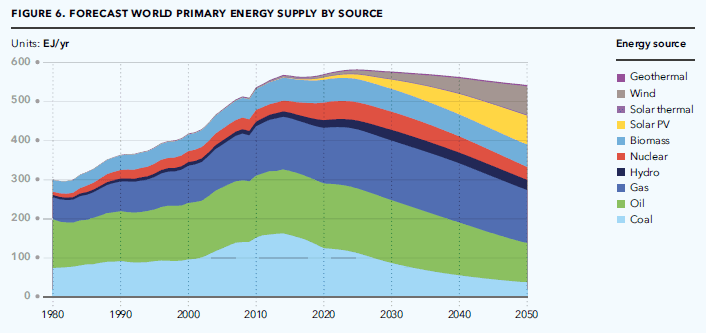
Despite progress on electricity generation, the transition is slower for Total Primary Energy Supply (TPES), where coal (industry) and oil (transport) hang on for longer. Because of the inefficiency of fossil energy sources, they can often look to persist longer in the energy system depending on the accounting system used.

Because of the persistence of oil, and growth in gas, DNV GL sees the need for more investments in oil and gas to satisfy forecast demand. Statoil comes to a similar conclusion in their Energy Perspectives, even when limiting temperature increase to 2°C.

Total Primary Energy Supply by source through to 2050. DNV GL see a big decline in coal use, persistent oil use, moderate growth in gas use, and strong growth in wind and solar use. Changes in energy supply can appear slow due to standard accounting methods which capture the inefficiencies of fossil-fuel energy use.

Despite the positive gains in different parts of the energy system, the changes are not sufficient to keep the world below 2°C as pledged in the Paris Agreement. Instead, DNV GL sees the average global temperature to be around 2.5°C above preindustrial levels by the end of the century.

The difference between 2°C and 2.5°C may sound small, but in terms of mitigation it is a big difference. Since DNV GL does not compare against a 2°C consistent scenario, the risks and opportunities of moving to a 2°C pathway are not quantified.

The DNV GL Energy Transition Outlook essentially tells us that we have a long way to go to 2°C, a point on which I agree.

ANNONSE
Bluesky

Les også

To menn i formelle antrekk sitter på gullkantede stoler i et overdådig rom, smilende og med hendene i fanget foran en utsmykket peis.

Fossil industri – og fossile land – har fått en ekstraomgang

Vi kan beklage det, men det er en realitet: Summen av Covid-pandemien, Ukraina-krigen og Donald Trump har gitt den fossile siden i klimakampen en ufortjent ekstraomgang.

28. november 2025
Les mer
En mann og en kvinne i forretningsklær går og snakker i en travel konferansesal, begge bærer nøkkelbånd med ID-brikker.

Omstilling vekk fra fossil energi: Over 60 land støtter veikart – Norge tar forbehold

Et initiativ for å fremme omstillingen vekk fra fossil energi har samlet støtte fra over 60 land på COP30. – Kan være en god ide, sier klima- og miljøminister Andreas Bjelland Eriksen.

18. november 2025
Les mer

Status Kina: utslippene, kullet og fornybarboomen

Kina er verdens største utslippsnasjon, verdens største forbruker av kull og verdens største utbygger av fornybar energi. Kina er både verst og best. Så hva er status for Kinas klimaomstilling?

13. november 2025
Les mer
Donald Trump iført marineblå dress og rødt slips taler fra FNs talerstol med mikrofoner og en glassvegg foran seg.

– USA oppfatter energiomstillingen som en trussel

USA under Trump motarbeider systematisk den globale energiomstillingen. EU og Kina kunne svart med felles klimasatsing, men EU har kjørt seg fast i egne problemer, sier ekspert på klimapolitikk Ole Adolphsen.

24. september 2025
Les mer
ANNONSE
Artikkelen fortsetter under annonsen
Annonse
Våre støttespillere
Svanemerket