1
2

Støtt oss
1
Stillinger
2
Klimakalender

Om oss

Om oss
Støtt vårt arbeid
Annonsere
Personvernerklæring
Administrer informasjonskapsler

Følg oss

Facebook
Bluesky
Linkedin
Rss feed

Kontakt oss

Redaksjonen
Energi og Klima
Odd Frantzens plass 5
N-5008 Bergen
til toppen
Peter Erickson
Peter Erickson
Staff Scientist in the Climate and Energy program in Stockholm Environment Institute's Seattle office.
Publisert 20. september 2017
Artikkelen er mer enn to år gammel
Articles in English

Norway’s elections put oil in the spot­light – now what?

A new study shows just how much Norway’s tax breaks will boost oil and gas production in the coming years.

Photo- Espen Rønnevik og Roar LindefjeldStatoil – Statoil – Aasta Hansteen substructure upending – 1457842_

How much more oil and gas will be extracted from Norwegian fields? Here work on the substructure for the Aasta Hansteen platform, July 3 2017 (Photo: Espen Rønnevik og Roar Lindefjeld, Statoil)

Publisert 20. september 2017
Sist oppdatert 15.9.2025, 23:27
Artikkelen er mer enn to år gammel
Peter Erickson
Peter Erickson
Staff Scientist in the Climate and Energy program in Stockholm Environment Institute's Seattle office.

Last week, the elections for parliament in Norway raised new questions about the future of oil and gas. Voters in this country, which is by far Europe’s top petroleum producer, re-elected Prime Minister Solberg and other leaders who are determined to expand the country’s oil and gas production. That view – though it won out at the polls – is shared by a declining fraction of the Norwegian public.

The obvious question is: Now what?

Not only about Barents Sea and Lofoten

Much of the public debate focused on making (or keeping) development off limits in the Barents Sea and the Lofoten archipelago, two areas that are also important for fishing and tourism. The debate here will continue, as the political parties remain split on new drilling in these areas.

But for leaders concerned about climate risks, they should also look to the south, to those oil fields in the Norwegian and North seas, where the government’s National Petroleum Directorate has already issued licenses.

Those fields would seem to be a sure bet for development and production, as the companies already have a good sense of what oil is there, and what it will cost to produce. But the fields must still pass standard financial hurdles of risk and return for the owners to press «go» and invest the capital required to build new offshore platforms.

That is where a new debate could emerge, especially given the Solberg government’s signal that it wants to offer further tax cuts to the petroleum industry. Norway’s tax system — long prized for its stability — is already widely believed to be too generous to the petroleum industry. As noted by last year’s Green Competitiveness Committee, current tax breaks may lead to over-investment in oil and gas and, in turn, increased global greenhouse gas emissions.

Artikkelen fortsetter under annonsen

No-go to investors without tax breaks

In a new study, just completed, a colleague and I show just how much the tax breaks will boost oil and gas production in the coming years.

We looked at two tax measures, called fast depreciation and uplift, that Norway provides solely to the oil industry. The first allows investors to postpone their tax payments; the second reduces those payments by allowing investors to deduct a portion of their investment twice.
Oljeskatt: Begreper og videre lesning
Artikkelen omtaler to sentrale begreper i det norske oljeskattsystemet. På norsk er «fast depreciation» rask avskrivning. «Uplift» er friinntekt. Les også:

  • Skatt og subsidier på sokkelen
  • Oljenæring i særstilling – intervju med Diderik Lund.
  • Rapport: Oljeskatten i energiomstillingens tid
  • Oljeskatten i energiomstillingens tid del 2

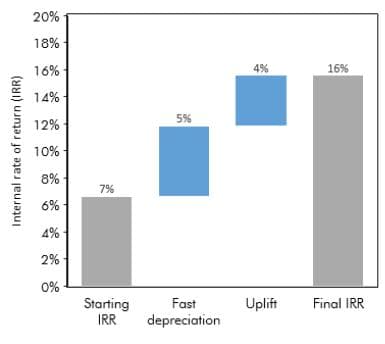
We found that these measures greatly boost industry returns, particularly at current oil prices of about $50 per barrel. Without the tax breaks, most new fields would be a no-go to investors, averaging about a 7 percent return on investment (in nominal terms). With them, that turns into a healthy 16 percent profit – enough to start drilling. (See Figure)

Våre støttespillere

Average impact of fast depreciation and uplift across all 700 oil and gas licenses assessed (Average on a production-weighted basis. Starting IRR includes corporate income tax and special petroleum tax).

A common benchmark of return in the oil industry is about 10% nominal. (If inflation is about 3%, then this lines up with the 7% real suggested in a recent exchange with Eirik Wærness, Chief Economist of Statoil.) This suggests that most of Norway’s oil investment would not take place but for these two measures. In fact, we found that a full 95 percent of Norway’s existing petroleum licenses — most of which are in the North Sea and the Norwegian Sea — would sit idle but for the help provided by fast depreciation and uplift.

These measures are tilting the economics of the petroleum industry in Norway, bringing 8 billion barrels of oil online, which would emit 2.3 Gt of carbon dioxide when burned. That would comprise about 1% of world’s remaining carbon budget for staying within a 1.5-degree carbon budget.

Removing tax breaks

Our results offer a possible path forward for leaders who value both fiscal discipline and climate limits. Removing fast depreciation and uplift would mean that most new capital investment — even in existing fields — would not proceed at current oil prices. That could be beneficial from the perspective of beginning a phase-down of Norway’s dependence on the petroleum industry. But it would still leave the door open to some oil production that makes fiscal sense if prices rise again, e.g. for the nearly half of the oil resources that would be economic at $70 per barrel even without fast depreciation and uplift.

The Ministry of Finance has taken great pains over many years to make the tax system stable, avoiding big shifts such as eliminating fast depreciation or uplift. Undoing these measures may not sit well with those who took great care to design the system that way. (There is also an argument that some, albeit a smaller, amount of uplift may be warranted.)

Still, stability in the global climate may demand something more than stability from the fossil fuel industry. Norway’s new leaders could instead pursue climate limits by providing the industry a different kind of certainty — by setting forth a new, strong, predictable tax and licensing system that fast-tracks Norway on its leadership role to a truly low emissions society. Phasing out fast depreciation and uplift would be a good start.

ANNONSE
Bluesky

Les også

Fossilbil-felle, oljenæringens CO2-avgift – og klimatrøbbel i landbruket

Er det best for folk i distriktene å få billigere bensin, eller bør staten heller gjøre elbilene i grisgrendte strøk rimeligere? Hvor stor er egentlig folks støtte til oljesektoren? Dette og mer kan du høre om i ukens Klimax.

21. november 2025
Les mer
Et kart over havområdene i Arktis som viser nominerte områder, bevaringsområder og SVO-områder for 2025, markert med røde, grønne og skisserte fargede soner. Havforskningsinstituttets logo er inkludert.

26. konsesjonsrunde i sårbar natur

Både klimahensyn og naturhensyn kan stoppe den 26. runden for oljeleting. Mesteparten av det foreslåtte arealet er «særlig verdifull og sårbar» natur.

4. november 2025
Les mer
Blid mann med briller og lyseblå skjorte og signalgul arbeidsjakke foran vannturbin ved et kontorbygg

Advarer mot statsstøtte til Barentshavet-rør 

Oljebransjen kan komme til å be om støtte til et gassrør fra Barentshavet, tror tidligere olje- og energiminister Tord Lien. – Da må svaret være nei, sier han.

15. oktober 2025
Les mer

Tuttifrutti-glede og blå klimamotstand

Hva kan vi forvente fra MDG og SV etter valgseieren for rødgrønn side? Og kommer det en anti-klimabølge i Høyre – eller vil partiet stå støtt på grønn omstilling?

12. september 2025
Les mer
ANNONSE
Artikkelen fortsetter under annonsen
Annonse
Våre støttespillere
Svanemerket
Ledige stillinger i det grønne skiftet

Vil du jobbe med klima og jordbruk?

Miljødirektoratet søker etter rådgivere med analytiske evner
Oslo
Frist: 4.12.2026