1
2

Støtt oss
1
Stillinger
2
Klimakalender

Om oss

Om oss
Støtt vårt arbeid
Annonsere
Personvernerklæring
Administrer informasjonskapsler

Følg oss

Facebook
Bluesky
Linkedin
Rss feed

Kontakt oss

Redaksjonen
Energi og Klima
Odd Frantzens plass 5
N-5008 Bergen
til toppen
Terje Osmundsen
Terje Osmundsen
Grunnlegger og adm. dir. Empower New Energy. Investor og styremedlem innen fornybar energi.
Publisert 16. april 2015
Sist oppdatert 25.3.2022, 10:24
Artikkelen er mer enn to år gammel
Articles in English

New study: 95 % renew­able power-mix cheaper than nuclear and gas

The cost to the consumer of the 100 % renewable scenario is more or less equal to a scenario close to today’s, with only 40 % renewables, a new French government study shows.

Publisert 16. april 2015
Sist oppdatert 25.3.2022, 10:24
Artikkelen er mer enn to år gammel
Terje Osmundsen
Terje Osmundsen
Grunnlegger og adm. dir. Empower New Energy. Investor og styremedlem innen fornybar energi.

Something remarkable is taking place that is bound to lead to a deep reshaping of the energy debate, starting in Europe and North America. It used to be the visionaries and the NGOs who talked about a 100 % renewable future, but now leading number-crunchers and energy experts are joining the chorus. In California, the government energy regulator were recently quoted saying that California’s power grid could handle 100 % renewables. 

The city of Vancouver is an example of a big city that recently committed to run 100 % on renewables for power, heating and transportation within 20 years. New studies have been released showing the US can get to 100 % renewables by 2050, at marginal extra cost.

France: 100 % renewable?

«Vers un mix électrique 100 % renouvable en 2050» is the name of the brand new report from ADEME, the government agency responsible for green and renewable energy. The publication of the report was considered controversial by the French government currently busy securing a majority in the Senate for the new energy transiton law that recommends an electricity mix with 50  % nuclear, down from 75 % today.

A political decision was therefore made to postpone the publication of the study, but after the media house Mediapart got hold of it, it is now published by ADEME.

The 120-page report (exluding attachments) provides a number of interesting and surprising insights. First of all, the study demonstrates that a 100 % renewable power system in France is both possible and economically attractive, also when taking into account a number of alternative scenarios including extreme weather, stricter regulations against wind, solar and high-voltage connections, slower technology development a.o.

Secondly: The cost to the consumer of the 100 % renewable scenario is more or less equal to a scenario close to today’s, with only 40 % renewables. The reason is simple: Whereas the cost of wind and solar continue to fall, the cost of natural gas including CO₂ will rise steadily. But also nuclear is becoming more expensive, primarily due to the new safety regulations.

Artikkelen fortsetter under annonsen
Table: Average cost of electricity 2015-2050 in High- and Low-Renewables scenario. Source: ADEME

The study describes a a new generation of wind technology that it believes will lead to less conflicts with local communities, and that people will accept the high number of new transmission links foreseen in the reference «High-Wind» scenario. For the same «rational» economic reasons, it does not expect rooftop PV to reach more than 10 % of total generation by 2050.

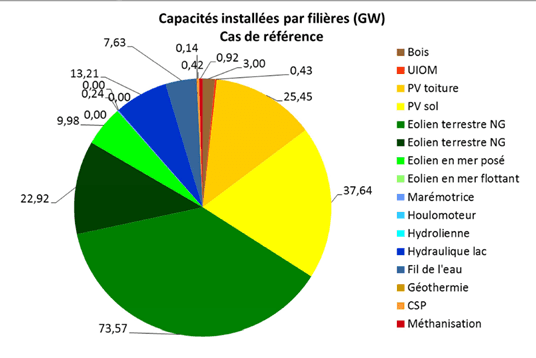
Figure 100 % Renewable: Sources per installed capacity. (Source: ADEME)

In my view, the study underestimates the potential disruptive power of solar PV compared to alternative sources of renewable and non-renewable energy. The Levelised Cost of Electricity (LCOE) for respectively ground mounted and rooftop PV will fall gradually and reach 6 and 8,5 €/MWh in 2050, the authors say. This makes ground-mounted PV cheaper than onshore wind in 2050, and the cost of rooftop PV roughly the same as wind power from fixed offshore farms. One big difference however, is that small and medium-sized PV are close to the load centers and hence cheaper to bring to the end-customer.

Furthermore, it should be noted that the assumptions regarding the cost of PV cited above are conservative; most industry experts would expect significantly lower costs in 2050. In addition, rooftop PV, and largely ground-mounted, are easy and relatively quick to develop and install.

Våre støttespillere

The outcome of all this would therefore most likely be that PV and wind would reach about equal share of the electrity mix in 2050, i.e. 35-40 % for each, bringing the total installed capacity of PV to the range of 80-90 GW. Not a bad performance for a country that so far has installed only about 4 GW.

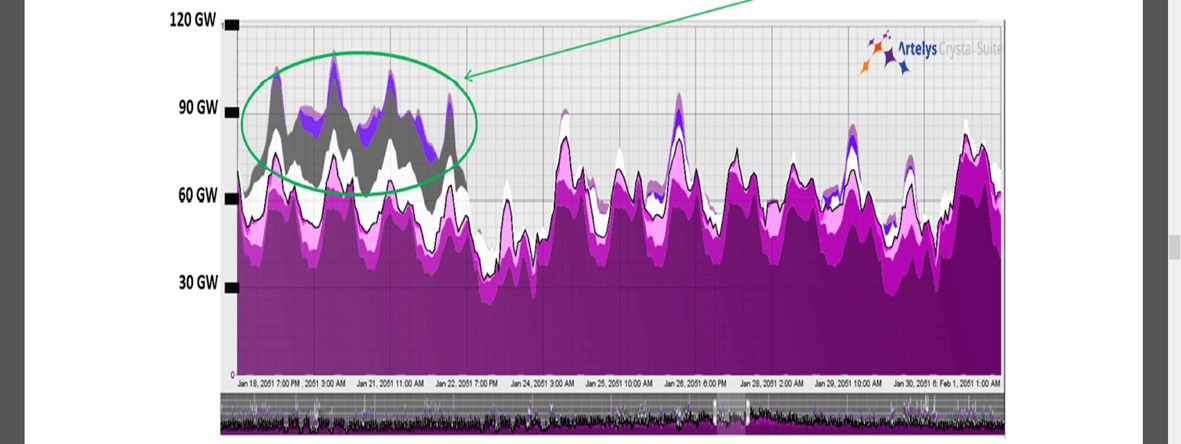
With wind and PV growing to 80 % of total power production in 2050, the study gives a lot of attention to how – and at what cost – the different regions can fill the gap when neither the wind nor the sun can meet the demand. What comes out is a combination of demand management (electric cars, for example, charging and discharging), import/export, short term storage (batteries and compressed air installations for example) and hydropower.

Figure: Simulation of power mix 2 weeks in January 2051 (Green:Stored electricity). Source: ADEME

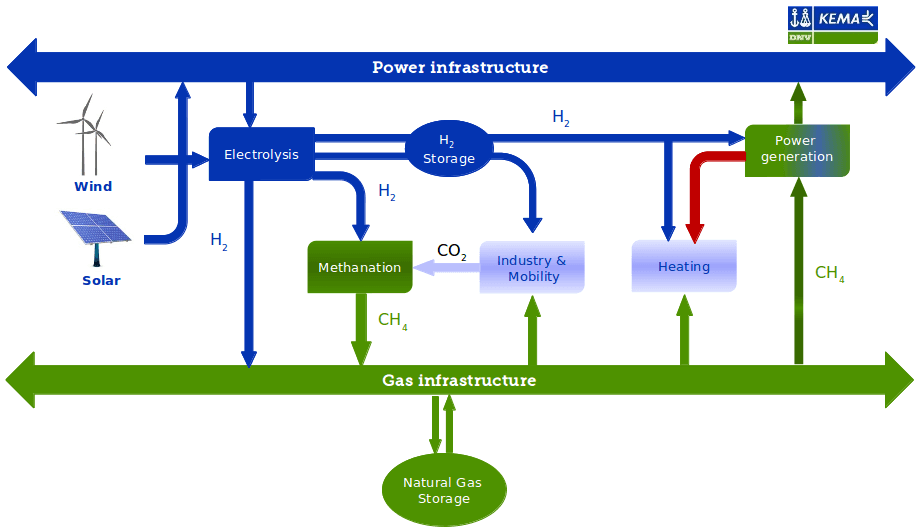
But the main contribution is long-term storage, from «Power to Gas» to «Gas to Power». In other words, the «hidden potential» for storage revealed in the ADEME study is not batteries, but cheap methane produced in a process of mixing CO₂ with hydrogen. The methane gas will then be stored, or be transported in the existing gas pipelines to a site for storage, and converted to peaking power during winter months. This hydrogen/methane route represents more than half of all storage solutions foreseen in the 100 % renewable scenario, equal to close to 20 GW in 2050.

Illustration: "Power to Gas" and "Gas to Power". Source: DNV GL
Illustration: «Power to Gas» and «Gas to Power». Source: DNV GL

It’s perhaps no coinsidence the French experts are so convinced by the methanisation way to storage. After all, the Sabatier reaction involving the reaction of hydrogen with carbon dioxide to produce methane and water was first discovered in France 100 years ago. The inventor was the French chemist Paul Sabatier.

ANNONSE
Bluesky

Les også

En arbeider iført varseljakke og hjelm går langs en stor industrirørledning en snørik dag.

Fryktar prissjokk på gass utan ein fossil utfasingsplan

Vekas fem på fredag-nyheiter: Tyskland treng ein utfasingsplan, ny CCS-runde i Storbritannia, Trumps fornybarstans kan ramme KI-satsing, kraftoverskot i Frankrike og Kina strupar sol-overkapasitet.

12. desember 2025
Les mer
På en fabrikk plasserer arbeiderne en stor pappeske merket med produktinformasjon på en pall med solcellepaneler.

Investorer strømmer til den grønne omstillingen

Denne ukens fem utvalgte nyheter: Ren energi-aksjer surfer på KI-bølgen, IEA ser fortsatt stor fornybar-fart, Trump-kutt i grønn statsstøtte, humanitært klima-visum og kjernekraft i Sveriges skjærgård.

10. oktober 2025
Les mer

Frankrike er i dyp krise og selverklært trumpist vant i Tsjekkia

PODKAST: – Det er betydelig risiko for at Frankrike kan ende opp der Tsjekkia er i dag med en populistisk ytre høyre-regjering som vil trekke landet lenger ut i klimaskepsis, sier Energi og Klimas korrespondent i Brussel, Philippe Bédos Ulvin.

8. oktober 2025
Les mer
En kvinne sitter ved et konferansebord med en mikrofon, et svensk navneskilt og et lite svensk flagg foran seg.

Sverige har trenert fornybardirektiv – risikerer millionbøter 

EU-kommisjonen saksøker Sverige i EU-domstolen for ikke å ha innført nye regler som skal korte ned saksbehandlingstiden for fornybar energi.

8. oktober 2025
Les mer
ANNONSE
Artikkelen fortsetter under annonsen
Annonse
Våre støttespillere
Svanemerket
Ledige stillinger i det grønne skiftet

Vil du jobbe med klima og jordbruk?

Miljødirektoratet søker etter rådgivere med analytiske evner
Oslo
Frist: 4.12.2026