2
4

2
Stillinger
4
Klimakalender
Glen Peters
Glen Peters
Senior Researcher at CICERO. Research on human drivers of global change, global carbon cycle, bioenergy, scenarios, sustainable consumption, international trade and climate policy, emission metrics, and too much more.
Publisert 17. august 2017
Sist oppdatert 15.09.2025, 21:22
Artikkelen er mer enn to år gammel
Articles in English

The policy vision to keep below 2°C warming

The science shows that the Paris Agreement requires removing carbon dioxide from the atmosphere at scale. We suggest a three-point plan for governments to make progress.
Publisert 17. august 2017
Sist oppdatert 15.09.2025, 21:22
Artikkelen er mer enn to år gammel
Glen Peters
Glen Peters
Senior Researcher at CICERO. Research on human drivers of global change, global carbon cycle, bioenergy, scenarios, sustainable consumption, international trade and climate policy, emission metrics, and too much more.

The mitigation challenge to keep below 2°C warming is immense, yet policy makers show no sign of incentivising business to research, develop and deploy the required technologies.

Photo opportunities with wind turbines and solar panels abound, but the science shows that the Paris Agreement requires removing carbon dioxide from the atmosphere at scale. Yet, carbon dioxide removal is something governments don’t seem to want to talk about.

In a commentary published in Nature Climate Change, Oliver Geden and I suggest a three-point plan for governments to make progress on carbon dioxide removal.

In the 2015 Paris Agreement, governments not only agreed to limit the temperature increase to "well below 2°C", but they also agreed to reach net zero emissions in the second half of the century.

The scientific consensus is that achieving zero emissions sets our sights too low, we need to produce negative emissions by removing carbon dioxide from the atmosphere.
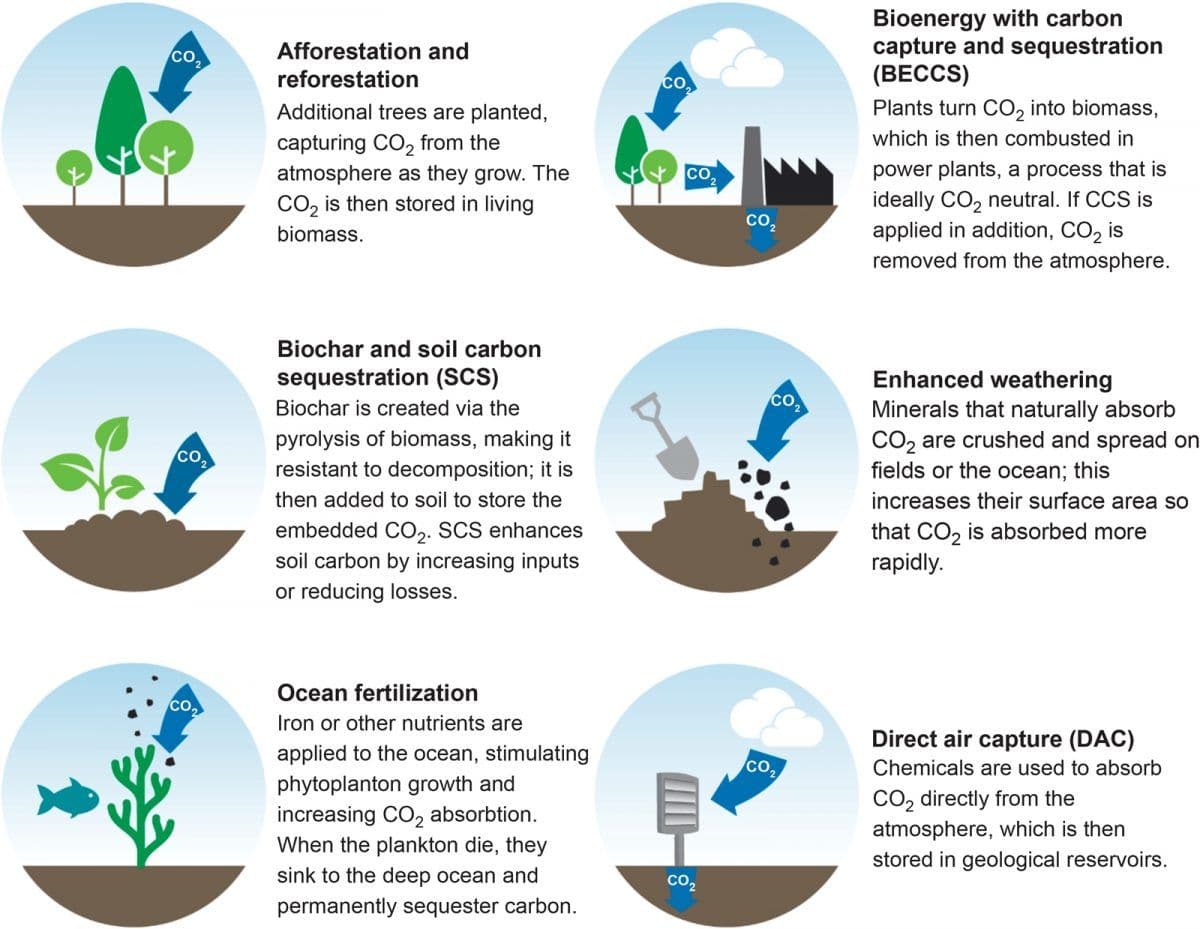
Overview of carbon dioxide removal technologies. From Minx et al (2017): "Fast growing research on negative emissions", Environmental Research Letters, Volume 12, Number 3.

While wind turbines and solar panels are the poster child of a low carbon economy, they can’t stop emissions in agriculture, industry, and some parts of transportation. We have also left deep mitigation so late, that we may need to overshoot the 2°C target and use carbon dioxide removal to bring the temperature increase back down to 2°C above pre-industrial levels.

Since mitigation in some sectors may be too costly, and we have emitted so much already, it may be cheaper to remove carbon dioxide from the atmosphere. Modelling suggests that it may be cost effective to deploy carbon dioxide removal technologies from 2020 so that they can remove as much as 25-50% of our current emissions by 2100.
Most policymakers, heads of state and government, seem to be unaware of the broader political implications of emission reductions in excess of 100%. There is no debate on the one issue that usually dominates climate negotiations – differentiation and burden-sharing.

Three-point plan

To kick start the debate, we suggest three concrete actions for policy makers to catalyse a political conversation about carbon dioxide removal.


  1. Begin negotiating differentiated carbon dioxide removal responsibilities to indicate potential pathways to net-zero emissions

  2. Develop a detailed system of accounting, supported by measurement, reporting, and verification, to track carbon and financial flows and responsibilities for carbon dioxide removal

  3. Develop policy portfolios capable of incentivising carbon dioxide removal, that go beyond encouraging small-scale boutique applications to support the necessary ‘gigatonne’ scale
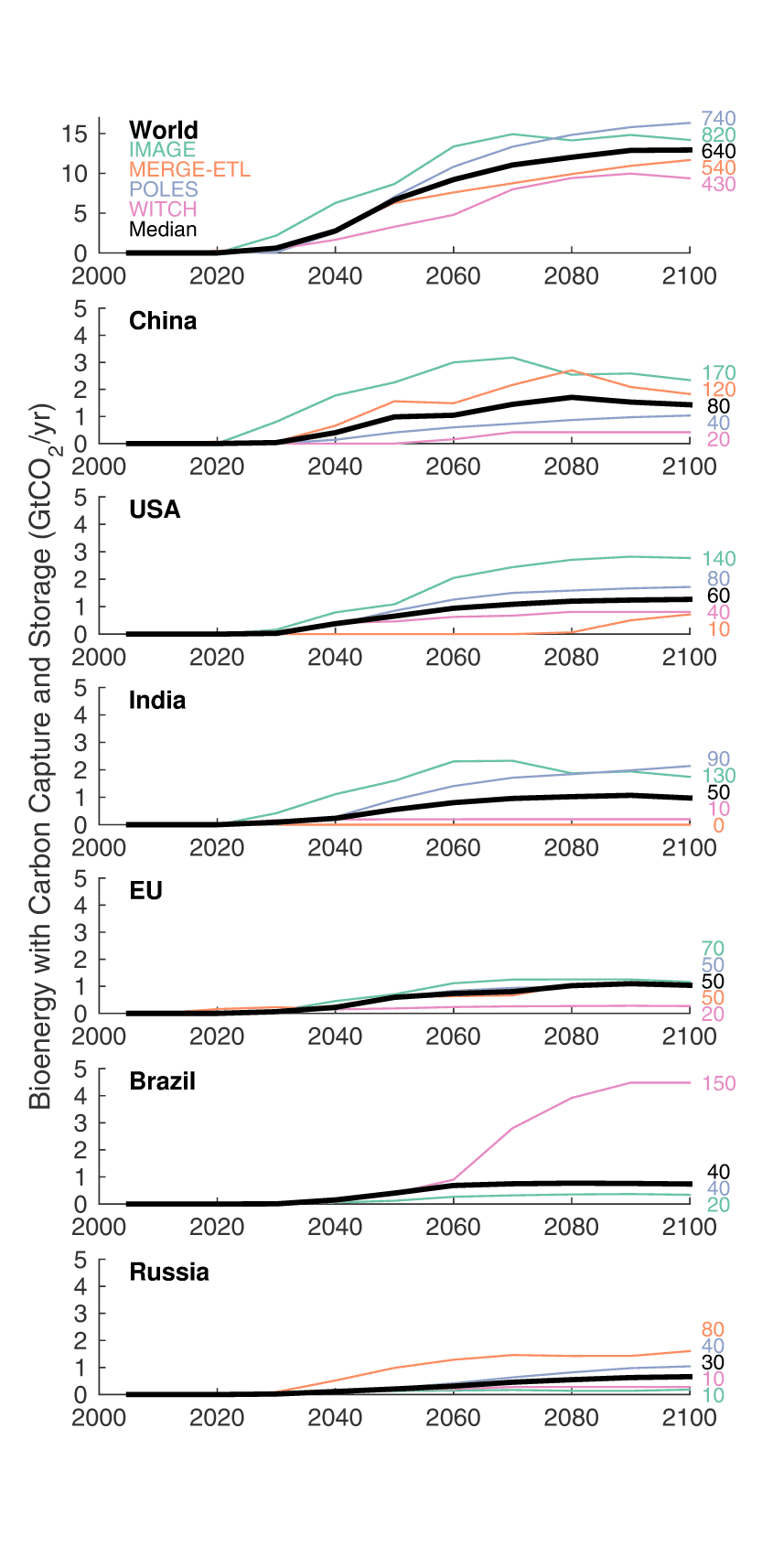
The scale of Bioenergy with Carbon Capture and Storage (BECCS) across different cost-optimal integrated assessment models. The different colours represent different IAMs and the black line is the average, the numbers to the right of the axis are cumulative values in 2100.

This blog post is a summary of the press release sent to journalists before the release of the paper.

ANNONSE
Bluesky

Om oss

Om oss
Våre støttespillere
Støtt vårt arbeid
Annonsere
Personvernerklæring
Administrer informasjonskapsler

Følg oss

Facebook
Bluesky
Linkedin
Rss feed

Kontakt oss

Redaksjonen
Energi og Klima
Odd Frantzens plass 5
N-5008 Bergen
til toppen
Støtt oss
Støtt oss
Artikkelen fortsetter under annonsen
Annonse
Våre støttespillere
Ledige stillinger i det grønne skiftet

NVE søker rådgiver

Rådgiver innen energibruk, dataforvaltning og digitalisering
Oslo, Trondheim, Tønsberg
Frist: 17.03.2026
Tre kollegaer som prater sammen rundt et bord

NVE søker rådgiver

Rådgiver innen EU-regelverk, energieffektive produkter og fornybar energi
Oslo, Trondheim
Frist: 11.03.2026
kaffepause kontor kollegaer