2
4

2
Stillinger
4
Klimakalender
Glen Peters
Glen Peters
Senior Researcher at CICERO. Research on human drivers of global change, global carbon cycle, bioenergy, scenarios, sustainable consumption, international trade and climate policy, emission metrics, and too much more.
Publisert 11. august 2017
Sist oppdatert 28.03.2022, 13:25
Artikkelen ble først publisert on the Cicero website August 10 2017.
Artikkelen er mer enn to år gammel
Articles in English

Can we trust emission stati­s­tics?

Many have reported that CO₂ emissions from fossil fuels and industry are flat, but we have had a record increase in CO₂ concentrations in the atmosphere. Yes, this is exactly what is expected!
can-we-trust-emission-statistics-featured.jpg

CO₂ concentrations have a well-known seasonal cycle (red) since there is more vegetation in the northern hemisphere, but the CO₂ concentration is continuously rising with our CO₂ emissions (grey/black).

Publisert 11. august 2017
Sist oppdatert 28.03.2022, 13:25
Artikkelen ble først publisert on the Cicero website August 10 2017.
Artikkelen er mer enn to år gammel
Glen Peters
Glen Peters
Senior Researcher at CICERO. Research on human drivers of global change, global carbon cycle, bioenergy, scenarios, sustainable consumption, international trade and climate policy, emission metrics, and too much more.

It is one of those issues that drives me nuts. Any comment on the slowdown in the growth of CO₂ emissions is followed by a response that the data must be bogus, because CO₂ concentrations have had a record increase.

Perhaps emissions statistics are bogus, but the record growth in CO₂ concentrations does not show that.

Emissions versus concentrations

Before we get to the details, we need to clarify a few terms:

The CO₂ concentration is a stock (like the volume of water in a lake) and the CO­2 emissions is a flow (like the river flow into the lake).

What causes the CO₂ concentration to change?

A plot of the CO₂ concentration is a fascinating curve, it shows the planet "breathing" as it goes in and out of seasons. There is more vegetation in the Northern hemisphere, and the CO₂ concentration drops as plants grow in the Northern spring and summer and CO₂ concentrations increase again following decay in autumn and winter.

This seasonal cycle averages out over a year, leading to a continuous increase in CO₂ concentration in the atmosphere due to continued CO₂ emissions.
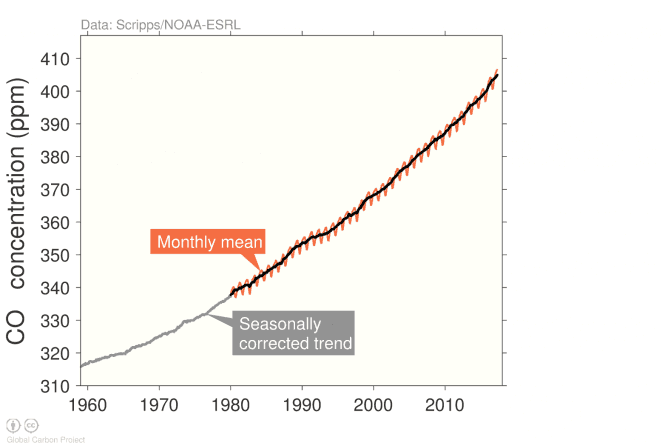
CO2 concentrations have a well-known seasonal cycle (red) since there is more vegetation in the northern hemisphere, but the CO2 concentration is continuously rising with our CO2 emissions (grey/black).

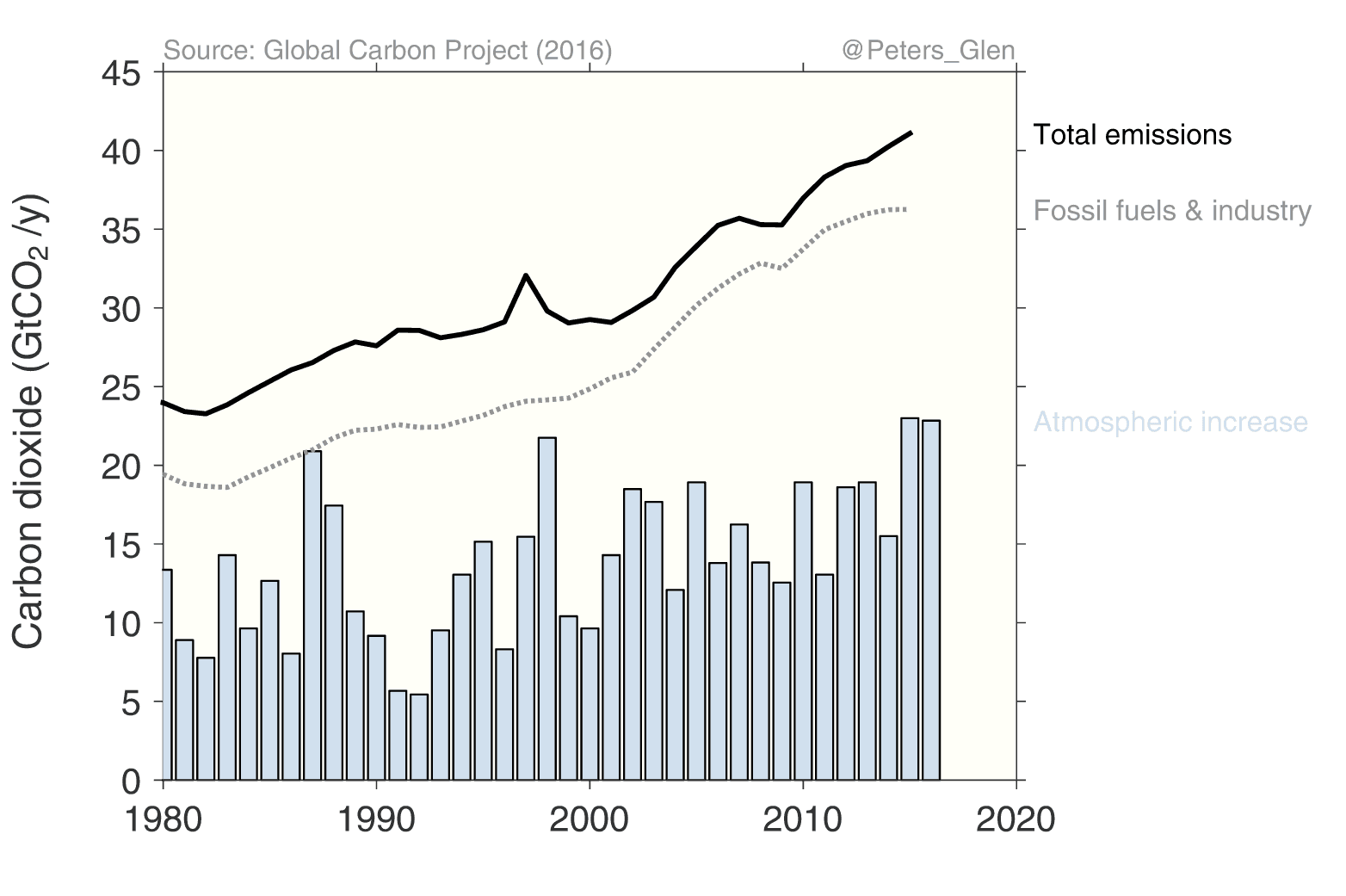
The annual change in CO₂ concentration is, however, not as smooth as the annual CO₂ emissions. I am not talking about the 400 parts per million in the atmosphere (stock), but the approximate 2 part per million (15 billion tonnes CO₂) annual increase in CO₂ concentrations that we have had in recent years.

The annual increase in CO₂ concentration quite nicely relates to the annual CO₂ emissions and a measure of sea surface temperatures that relates to El Niño events. El Niño events lead to a drying of tropical land regions and more forest fires, and therefore correlate with changes in atmospheric CO₂ concentrations.
This relationship is well established, and Richard Betts and colleagues quite nicely used the relationship with a climate model to estimate CO₂ concentrations one year ahead. They have repeated the forecast this year with uncanny accuracy. Richard explains more at Carbon Brief.

We know this relationship works, and it is worth writing it down:

Annual increase in CO₂ concentrations is proportional toAnnual CO₂ emissions (fossil fuels, industry, and land use change), andSea Surface Temperature Anomaly in the Pacific (indicator of El Niño)

With this knowledge, we can now look at why the increase in CO₂ concentrations is a record high, even though CO₂ emissions from fossil fuels and industry have not grown for three years.

The atmospheric increase (blue bars, measured in GtCO2/yr) in comparison to CO2 emissions from fossil fuels and industry (dotted line) and total emissions (solid line) which includes net emissions from land-use change.

Record emissions equals record atmospheric increase!

The short answer is that if CO₂ emissions from fossil fuels and industry are flat, it still means they are a record high. If we emitted 36 billion tonnes CO₂ from fossil fuels and industry in 2014, 2015, and 2016, we would expect, all else equal, for 2014, 2015, and 2016 to have a record increase in CO­2 concentrations. And guess what, we did!

The longer answer, is that there are two important nuances to add.

First, El Niños are important. In an El Niño year, there is a much larger increase in atmospheric concentrations since important land sinks in the tropics are not as efficient. 2015/2016 was a big El Niño year, as was 1997/1998. In 2015/2016, we had record high emissions, and a very big El Niño, and so we expect a record increase in CO₂ concentrations.

Second, CO₂ emissions from fossil fuels and industry were flat, but not those from land use change. In fact, the land-use change emissions are generally higher in El Niño years, amplifying the atmospheric increase. Total CO₂ emissions were not flat in the last three years.

Airborne fraction

Perhaps emission statistics are bogus, perhaps we have hit some nonlinear feedback, but current data on CO₂ emissions and CO₂ concentrations do not show this. Teasing out these and similar factors is notoriously difficult.

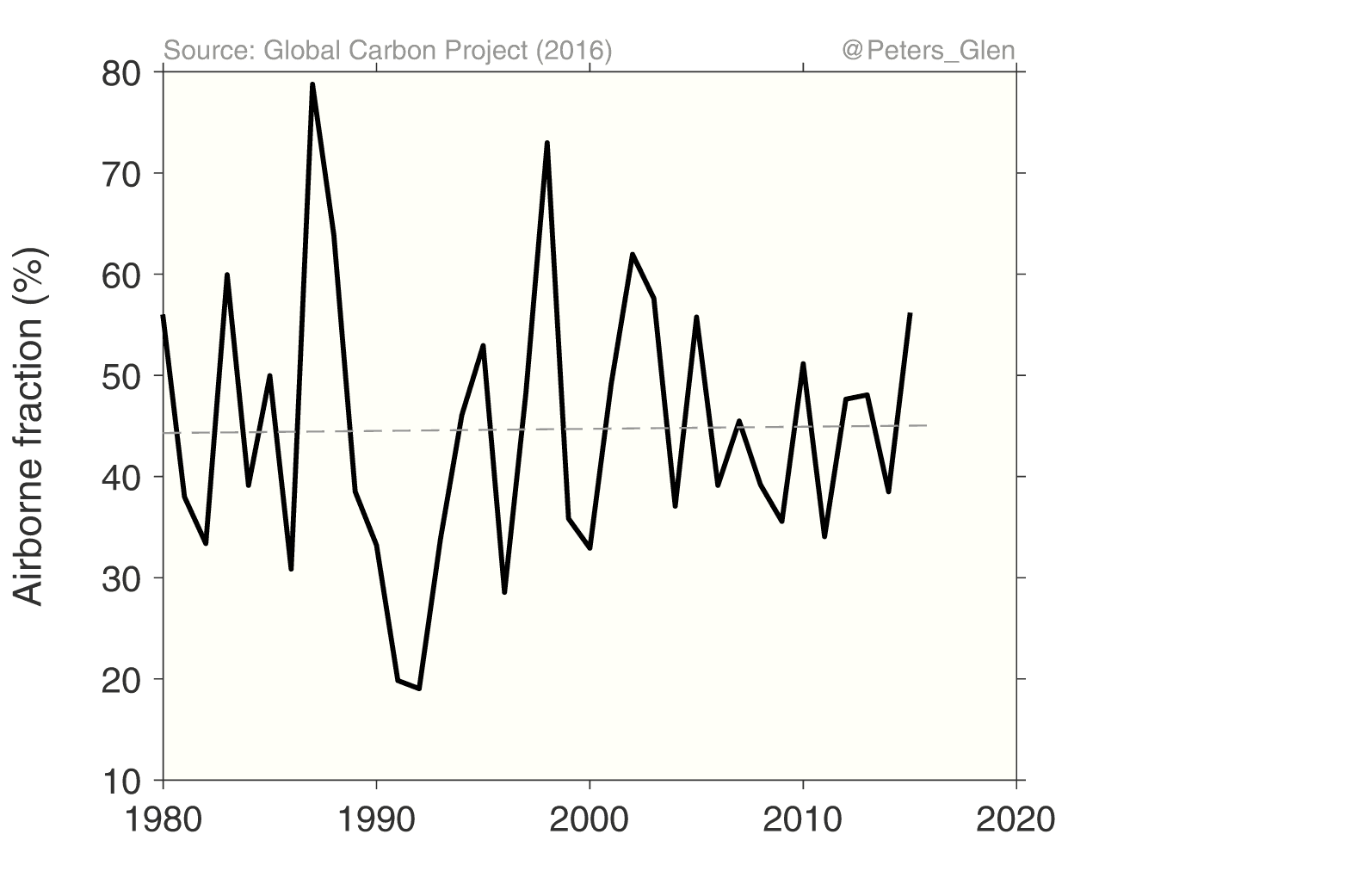
Researchers have used the airborne fraction, the share of CO₂ emissions that remain in the atmosphere (the annual increase in CO₂ concentrations divided by the annual CO₂ emissions), as an indicator of feedback processes. The airborne fraction has stubbornly remained around 45%, and detecting changes in such noisy data is not easy.

An interesting scientific question, currently unanswered, is when would we be able to detect a slowdown in CO₂ emissions or dodgy reporting via measurements of atmospheric CO₂ concentrations.

Changes in the share of CO2 emissions that remain in the atmosphere (airborne fraction, the annual increase in CO2 concentrations divided by the annual CO2 emissions) may indicate feedback processes, but it is hard to find a statistically robust signal.

Now take a coffee…

Listen to a BBC documentary (Counting Carbon) on emission statistics, uncertainty, monitoring, and the implications for the Paris Agreement.

And watch the planet breathe...

ANNONSE
Bluesky

Les også

budsjettforhandlinger-metanhemmere-i-kufor-og-ieas-world-energy-outlook-featured.jpg

Budsjett­forhandlinger, metanhemmere i kufôr – og IEAs World Energy Outlook 

Det er klart for forhandlinger i Stortinget mellom de rødgrønne partiene og Arbeiderpartiet. Motsetningene er store blant annet når det gjelder CO₂-avgift på bensin og diesel.
14. november 2025
Les mer
To arbeidere iført sikkerhetsvest og hjelm inspiserer og vedlikeholder et stort utendørs solcellepanelanlegg på en solrik dag.

Verdens utslipp øker tross rekordvekst i sol

Dette er bare ett av paradoksene i den årlige omfattende gjennomgangen forskere gjør av klodens karbonbudsjett. Glen Peters fra Cicero forklarer.
13. november 2025
Les mer

Om oss

Om oss
Våre støttespillere
Støtt vårt arbeid
Annonsere
Personvernerklæring
Administrer informasjonskapsler

Følg oss

Facebook
Bluesky
Linkedin
Rss feed

Kontakt oss

Redaksjonen
Energi og Klima
Odd Frantzens plass 5
N-5008 Bergen
til toppen
Støtt oss
Støtt oss
Artikkelen fortsetter under annonsen
Annonse
Våre støttespillere
Ledige stillinger i det grønne skiftet

NVE søker rådgiver

Rådgiver innen energibruk, dataforvaltning og digitalisering
Oslo, Trondheim, Tønsberg
Frist: 17.03.2026
Tre kollegaer som prater sammen rundt et bord

NVE søker rådgiver

Rådgiver innen EU-regelverk, energieffektive produkter og fornybar energi
Oslo, Trondheim
Frist: 11.03.2026
kaffepause kontor kollegaer