1

Støtt oss
Stillinger
1
Klimakalender

Om oss

Om oss
Støtt vårt arbeid
Annonsere
Personvernerklæring
Administrer informasjonskapsler

Følg oss

Facebook
Bluesky
Linkedin
Rss feed

Kontakt oss

Redaksjonen
Energi og Klima
Odd Frantzens plass 5
N-5008 Bergen
til toppen
Glen Peters
Glen Peters
Senior Researcher at CICERO. Research on human drivers of global change, global carbon cycle, bioenergy, scenarios, sustainable consumption, international trade and climate policy, emission metrics, and too much more.
Publisert 1. november 2017
Artikkelen ble først publisert on the Cicero website October 26, 2017.
Artikkelen er mer enn to år gammel
Articles in English

Have we discounted our future?

The large-scale carbon dioxide removal in emission scenarios is becoming better known, but is it just a consequence of high discount rates?

Publisert 1. november 2017
Sist oppdatert 15.9.2025, 23:33
Artikkelen ble først publisert on the Cicero website October 26, 2017.
Artikkelen er mer enn to år gammel
Glen Peters
Glen Peters
Senior Researcher at CICERO. Research on human drivers of global change, global carbon cycle, bioenergy, scenarios, sustainable consumption, international trade and climate policy, emission metrics, and too much more.

There are different types of Integrated Assessment Models (IAMs). In the climate world, we usually differentiate two. One type looks at cost-benefit analysis of climate impacts, such as, DICE, FUND, PAGE. Another type looks at cost-effective energy system transformations to stay below a given temperature level, such as, GCAM, IMAGE, MESSAGE, REMIND, and many more.

The models focussing on cost-benefit analysis often look at the social cost of carbon, and because of their relative simplicity, they do rather comprehensive uncertainty analyses.

The models focussing on energy system transformations, the ones that most interest me, focus on multiple scenarios and technological detail. I often see very little sensitivity analysis from these models, or at least I can’t find it!

I recently came across a blogpost by William Nordhaus, looking at cost-benefit and cost-effective analysis. For those that don’t know Nordhaus, he is a pioneer on the economics of climate change.

These days, climate scientists think they are cool when they are working on 1.5°C or geoengineering. Well, Nordhaus had that research done-and-dusted when today’s climate scientists were in nappies, me included. (Ok, I exaggerate, but I was probably still in nappies when Nordhaus started working in this area).

The blogpost gives a nice summary of the different types of models and there uses, but I was immediately drawn to the results.

I am sure people don’t like DICE and don’t like models, but I don’t care! I am interested in processes here, not exact numbers.

Artikkelen fortsetter under annonsen

Nordhaus compares several scenarios:

  • Baseline: No climate-change policies are adopted
  • Optimal: Climate-change policies maximize economic welfare, with full participation by all nations starting in 2020
  • Temperature-limited: The optimal policies are undertaken subject to a further constraint that global temperature does not exceed 2.5°C above the 1900 average. (The international goal of 2°C is not feasible with current DICE estimates without technologies that allow negative emissions by mid-21st century).
  • Stern discounting: These are results associated with an extremely low discount rate as advocated by The Stern Review on the Economics of Climate Change.

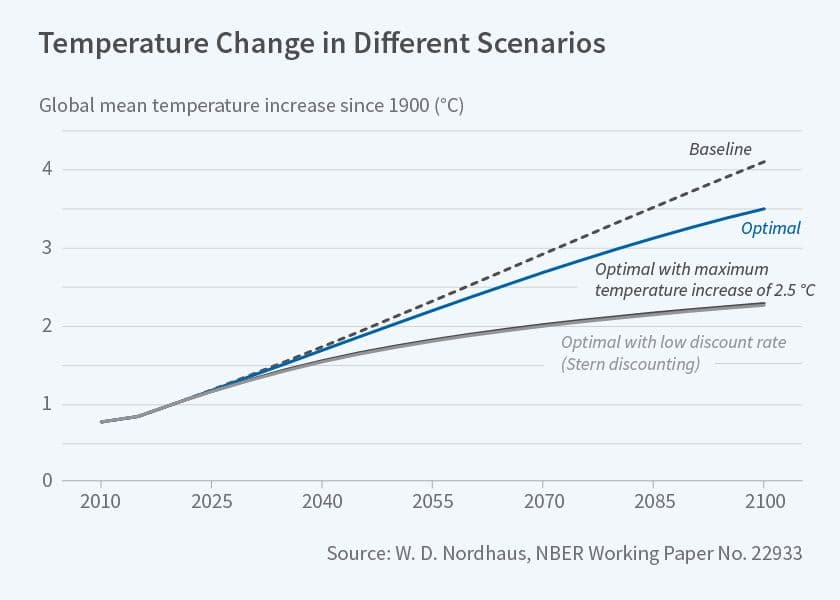
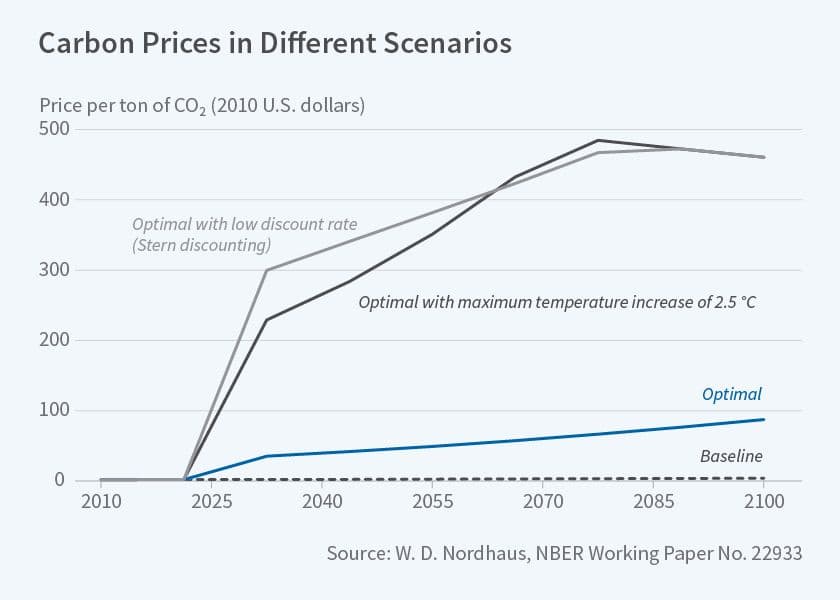
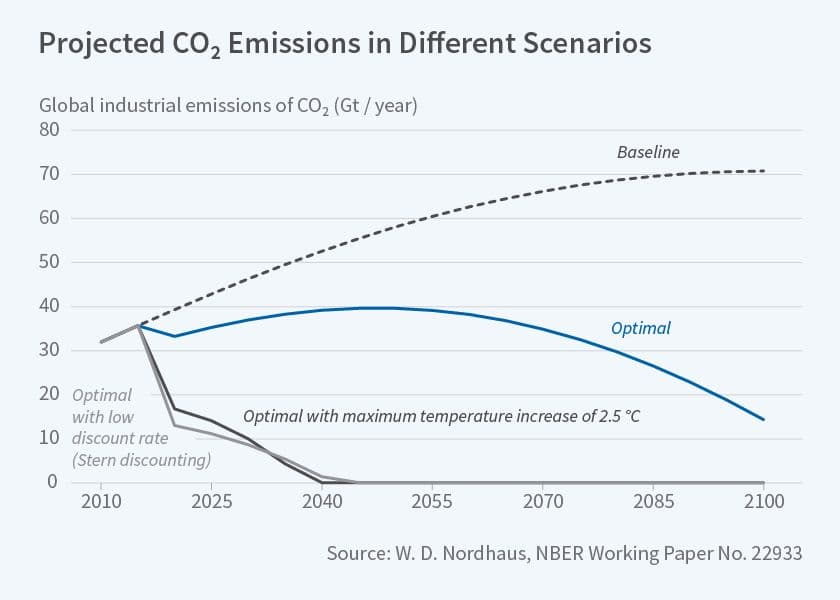
Here I want to discuss the three figures, and their key results.
The optimal path represents a balance between costs and benefits. There are many assumptions behind these estimates, but one key one is the discount rate. The discount rate used for this calculation averages 4-5%/yr over the 21st century. This takes the world to 3°C in 2100. Ok, warmer than many would like, but that is not the point here.

The cost-effective pathway takes the world to 2.5°C in 2100. In this calculation, the model is run in a way that ensures that it stays below 2.5°C, irrespective of the cost. The carbon price in this scenario is high, reaching over 200$/tCO2 in 2030, compared to less than 50$/tCO2 in the optimal pathway. In 2100, the carbon price is nearly 500$/tCO2 in the cost-effective pathway, compared to about 100$/tCO2 in the optimal pathway.

Våre støttespillere

The interesting thing is when a cost-benefit calculation is done to get the optimal pathway, but using a low discount rate. The low discount rate causes deep near-term mitigation, similar to that in the cost-effective pathway that forces temperatures to stay below 2.5°C. Of course, carbon prices are high, but temperatures are limited to 2.5°C. The temperature-limited and Stern discounting pathways are probably similar since DICE cannot go any lower without carbon dioxide removal.

Why do I find these results interesting?

The current generation of energy-system integrated assessment models don’t seem to do much sensitivity analysis. I have long been wondering if low discount rates would lead to lower levels of carbon dioxide removal.

A nice study by Detlef van Vuuren and colleagues notes:

Models tend to indicate that too rapid short-term reductions could be expensive compared to the cost of negative emissions in the long term (based on expected technology development rates and assumed discounting rates), and thus favour strategies in which considerable levels of net negative emissions are applied.

And another on direct air capture by Chen Chen and Massimo Tavoni looks at discount rates and notes:

[W]hen time preference is zero and no discount is applied to future mitigations costs vis à vis with current ones, we can observe significantly lower deployment of [Direct Air Capture]

I am sure there are other studies here and there, but I am not aware of a comprehensive analysis. Such an analysis is needed, and could be important to understand technology deployment in the current generation of emission scenarios.

Is our love of carbon dioxide removal, and soon solar geoengineering, simply because we discount the future? I would love an answer to that question. Any takers?

CO₂ emissions for a cost-effective path to 2.5°C are comparable to welfare maximising path with low discount rate.
Climate-change policies that maximize economic welfare may lead to warming of 3.5°C by 2100, a cost-effective model with a temperature limit is required to keep temperatures lower.
Low discount rates, or cost-effective path to 2.5°C, would require carbon price of around 300USD/tCO₂ in 2030, significantly larger than the carbon price in an optimal pathway.
ANNONSE
Bluesky

Les også

Globale utslipp videre opp – stor økning i USA

Globale CO₂-utslipp er nå 10 prosent høyere enn da Parisavtalen ble vedtatt i 2015. Også i 2025 øker utslippene til ny rekord – USA bidrar sterkt med kulldrevet vekst.

13. november 2025
Les mer
En mann i dress snakker foran en blå bakgrunn med EU-flagget med gule stjerner i en sirkel.

EU-landene enige: Klamrer seg til skjørt klimamål for 2040

EU skal kutte utslippene med 90 prosent innen 2040, men med massiv kvotebruk og jevnlige muligheter for å senke målet.

5. november 2025
Les mer
En gutt i tanktop og shorts sparker fotball på gresset, med en nedfallen strømstolpe og ledninger i bakgrunnen, og husdyr som beiter i nærheten.

Omstilling i klimaendringenes tid

Energiomstillingen – kuttene i utslipp – skal skje samtidig som klimaendringene biter stadig hardere.

1. november 2025
Les mer
En person holder en håndholdt optisk enhet opp til øyet og ser gjennom den utendørs på en solrik dag.

Utslippsregnskapet for CO2: Norge ber EU om avklaringer om hvordan kutt skal bokføres 

Klima- og miljøminister Andreas Bjelland Eriksen har skrevet til EUs klimakomissær, Wopke Hoekstra og bedt om fortgang i avklaringer rundt Norges klimasamarbeid med EU. 

30. oktober 2025
Les mer
ANNONSE
Artikkelen fortsetter under annonsen
Annonse
Våre støttespillere
Svanemerket