Key indicators to track current progress and future ambition of the Paris Agreement
We have had three years with virtually no growth in carbon dioxide emissions from fossil fuels and industry. What has caused the slowdown and does this put us on a path to «well below 2°C»?
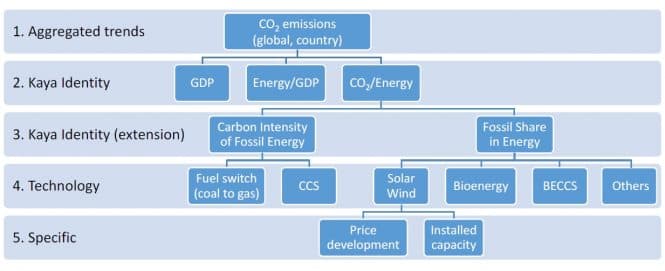
Nested structure used to analyse the slowdown in global emissions growth. (Illustration: Peters)
Senior Researcher at CICERO. Research on human drivers of global change, global carbon cycle, bioenergy, scenarios, sustainable consumption, international trade and climate policy, emission metrics, and too much more.
We recently developed a methodology to answer these questions. We selected 'key indicators' that map to the most important factors causing emissions to change. These 'key indicators' are also components of the emission pledges countries submitted to Paris Agreement (Nationally Determined Contributions), and they are key characteristics of emission pathways that limit global warming to 1.5°C or 2°C.
The 'key indicators' are nested in a hierarchical framework. This allows us to first focus on simple and overarching indicators, and then later zoom in to analyze more detailed and relevant components. As one penetrates deeper into the nested framework, the analysis can be made more relevant for individual countries.
Nested structure used to analyse the slowdown in global emissions growth. (Illustration: Peters)
The 'key indicators' include essential information such as greenhouse gas emissions, gross domestic product, and energy use. Much of this information is reported by countries to various international bodies (e.g., UNFCCC, United Nations, International Energy Agency), but for practical purposes we often use harmonized data from third-parties. It would be preferable if the data required for the analysis of recent trends and emission pledges was provided by countries, to ensure consistency and reduce uncertainties.
Other 'key indicators' could include planned infrastructure, public and private expenditure on research and development, patents, and implemented and planned policies. Data for these 'key indicators' are harder to obtain, and scientific developments are needed to understand how these 'key indicators' may be used to anticipate future emission reductions.
In the peer-reviewed article, we focus on 'key indicators' describing the recent slowdown in the growth of global carbon dioxide emissions from fossil fuels and industry.
China, the US, and the European Union have all seen emission reductions recently. These countries are affected by lower than expected economic growth since the Global Financial Crisis in 2008/2009, but there is an emerging trend due to the shift from coal to gas and the rapid growth in solar and wind.
While solid progress has been made in the deployment of solar and wind in these countries, the continual lack of large-scale deployment of carbon capture and storage makes it more challenging to keep global warming "well below 2°C".
To learn more about the methodology, have a look at the additional material: