1

Støtt oss
Stillinger
1
Klimakalender

Om oss

Om oss
Støtt vårt arbeid
Annonsere
Personvernerklæring
Administrer informasjonskapsler

Følg oss

Facebook
Bluesky
Linkedin
Rss feed

Kontakt oss

Redaksjonen
Energi og Klima
Odd Frantzens plass 5
N-5008 Bergen
til toppen
Terje Osmundsen
Terje Osmundsen
Grunnlegger og adm. dir. Empower New Energy. Investor og styremedlem innen fornybar energi.
Publisert 2. mai 2018
Artikkelen er mer enn to år gammel
Articles in English

No solar revo­lu­tion without deep inno­va­tion

Will the growth in soler energy flatten out after 2030, or will it be sustained with solar energy becoming the world’s leading energy source from 2050 onwards?

Publisert 2. mai 2018
Sist oppdatert 15.9.2025, 23:54
Artikkelen er mer enn to år gammel
Terje Osmundsen
Terje Osmundsen
Grunnlegger og adm. dir. Empower New Energy. Investor og styremedlem innen fornybar energi.

At a time when the solar PV industry is almost daily setting world records, the author of the book «Taming the Sun», the 29-year-old Stanford scientist and ex McKinsey consultant Varun Sivaram, pours cold water in the blood of those who assume that cheaper solar silicon cells, batteries and electric cars, will lead us towards the wanted solar revolution.

(Les norsk versjon av artikkelen).

Solar PV will be hit by «value deflation», he warns, when on sunny days the grid is injected with too much of it, as we already see signs of in Chile and Germany, for example.
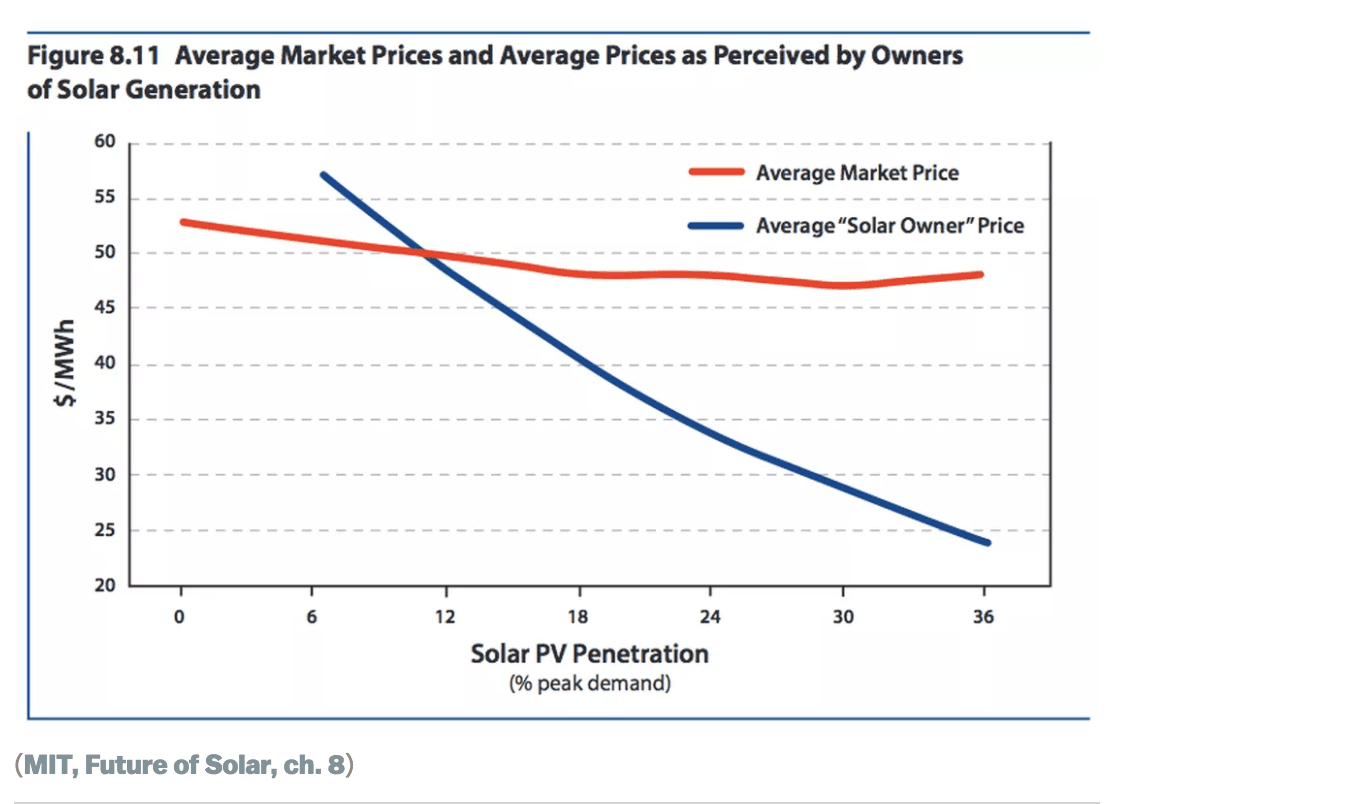
Value deflation in solar power.

But Sivaram is fundamentally an optimist and believes continued growth in solar energy is the key to success in achieving the goals of the Paris agreement. However, such sustained growth is dependent upon deep innovation in three areas: technology, financing, and energy market organization.

Perovskite and solar fuels

Taming the Sun, new book by Varun Sivaram.
Artikkelen fortsetter under annonsen

The «working horse» in the solar cell industry, silicon, has shown impressive progress and cost reductions over time. However, silicon is unable to be cheap and/or efficient enough to provide growth when market prices for solar power have fallen by around 75 percent, which Sivaram warns will occur sometime after 2030. It is therefore necessary to invest more in the development of alternative materials. Sivaram particularly focuses on perovskite, which scientists currently produce synthetically, and which is both flexible and has the ability to capture greater bandwidth and thus can provide higher efficiency than silicon. For example, by adding three layers of perovskite within a solar cell, efficiency can be increased to more than 40 percent, according to Sivaram, almost double that of what can be reached with today’s silicon technology. Oxford Photovoltaics has announced that they will start selling solar cells consisting of silicon plus a layer of perovskite in the latter half of 2018. Statoil is one of the investors in Oxford Photovoltaics.

That said, although solar cells consisting of perovskite can in theory provide more cost-effective solar cells, Sivaram appears to underestimate the challenges of scaling up. Banks and insurance companies, for example, will probably hesitate in financing and insuring solar parks using the perovskite technology, until it has proven its robustness over several years on the ground.

In the book we also meet research teams working on various technologies to produce «solar fuels». While batteries are suitable for storing power for up to 4-5 hours, liquid solar energy can be used when needed, as a replacement for fossil fuels in turbines and as an alternative to oil products in the transport sector. Sivaram believes thermal solar power, which utilizes solar radiation to heat liquid, can become competitive when researchers have succeeded in increasing the temperature of the stored liquid. As for hydrogen, the researchers working on so-called photoelectrochemical solar (PEM) cells, that produce hydrogen by imitating photosynthesis, i.e. splitting water into hydrogen and oxygen, have made promising progress lately. Sivaram is also optimistic regarding the work research teams are carrying out on technologies that use sunlight and bacteria to produce carbonaceous fuels directly, without first going through producing hydrogen.

No one today can know categorically which of these technologies will succeed, but there is nevertheless a need for a sharp increase in R & D efforts to increase the chances for successful scaling and commercialisation, the author argues. Following the recent budget allocations by the US Congress, one might believe Sivaram’s wishes had already been heard. In March this year, not only did the Congress reverse President Trump’s proposed halving of the Energy Department’s R & D budget, it made significant budget increases. The largest R & D growth went into the area of ​​clean energy storage.

Våre støttespillere

Unlocking the financial markets

In order to reach the Paris goals, the rate of investment into solar and other renewable infrastructures must triple, experts estimate. This would require more than 2.5 thousand billion dollars up to 2040, beyond what already exists, according to Bloomberg. The figures are so large that only institutional investors, i.e. pension funds and sovereign funds such as the Norwegian Oil Fund, can make a difference. Together, these funds manage more than 100,000 billion dollars. But mainstream funds have so far been reluctant to invest in renewable energy assets, due to a lack of suitable and liquid instruments. Renewable energy investments must exit from the world of the costly Private Equity model, and be more focused on securitising the assets, for example through yield-generating holding companies, so-called ´Yieldcos´, as well as through green bonds, argues Sivarem.

It is too risky to believe that nuclear power or carbon capture will enable us to reach the 2-degree goal. Only huge investments into sun and wind energy power, supported by storage and grid enhancement, will enable us to achieve it, warns Sivaram. Likewise, it would be risky not to take the warnings in «Taming the Sun» seriously.

ANNONSE
Bluesky

Les også

Industrielt raffinerikompleks med flere blå lagertanker, destillasjonstårn og rørledninger under en overskyet himmel.

Kan Europa greie seg uten norsk gass?

Det trengs beredskap når sola og vinden svikter, det kan ta tid og bli dyrt å bygge nok kraftledninger til Europas elektrifisering. Inntil videre bør vi derfor produsere norsk gass, mener Gerard Doorman.

2. desember 2025
Les mer

Sjette måned på rad med over 95 prosent elbiler

November var sjette måned på rad at elbiler utgjorde mer enn 95 prosent av nybilsalget.

2. desember 2025
Les mer

Disse sektorene slipper ut mest globalt

Produksjon av elektrisk kraft og industrien er de to sektorene som står for de største direkte utslippene av klimagasser.

1. desember 2025
Les mer
Flyfoto av et lasteskip og en slepebåt i nærheten av en havn med industribygninger og en kystlinje i bakgrunnen.

EU peker ut tre prosjekter i Norge for å styrke energiunionen 

Prosjektene – som alle handler om CO₂-lagring eller -transport – kan nå søke om støtte fra et fond på 244 milliarder kroner.  

1. desember 2025
Les mer

Global kraftproduksjon

Kraftmiks og energikilder.

1. desember 2025
Les mer
Tre personer sitter ved et bord med mikrofoner under en pressekonferanse; kvinnen i midten smiler, mens de to mennene på hver side virker fokuserte.

Budsjettforliket ga dobbel seier til Senterpartiet

Senterpartiet og Trygve Slagsvold Vedum får det som han vil – både når det gjelder oljepolitikken og avgiftene på diesel, bensin og kunstgjødsel. Det er lett å forstå SV og MDGs misnøye – og underlig at Ap lar Sp dempe bruken av klimaavgifter.

30. november 2025
Les mer

Kvotemarked: EU og verden

Utviklingen i prisen på utslipp av CO₂.

30. november 2025
Les mer
To menn i formelle antrekk sitter på gullkantede stoler i et overdådig rom, smilende og med hendene i fanget foran en utsmykket peis.

Fossil industri – og fossile land – har fått en ekstraomgang

Vi kan beklage det, men det er en realitet: Summen av Covid-pandemien, Ukraina-krigen og Donald Trump har gitt den fossile siden i klimakampen en ufortjent ekstraomgang.

28. november 2025
Les mer

Utslipp: Sektorer

Globale klimagassutslipp fordelt på sektorer.

28. november 2025
Les mer
grafikk ekstremvarme verden delt i regioner

Ekstremvarme og hetebølger

Ekstreme temperaturer: Utvikling og konsekvenser.

28. november 2025
Les mer
ANNONSE
Artikkelen fortsetter under annonsen
Annonse
Våre støttespillere
Svanemerket