Paris can renew carbon markets; speed up renewables
Paris December 7:
"Will Paris get the cash rolling?" That’s the subject of my address at a seminar on climate finance organized by CICERO and Climate Policy Institute Wednesday here in Paris. Judging from the "Draft Agreement" circulated by the COP21 presidency this weekend, there is still a long way to go before we can say the Paris summit will be able to unleash the billions of private money needed to speed up the investments in renewables in developing countries. But the seeds of a new climate finance architecture are there.
The national action plans submitted to the Paris climate summit show there is now an unprecedented commitment from developing countries to increase the share of renewables in the total energy-mix. But availability of funding slows implementation, and haggling over how to finance the climate bill threatens to make COP21 yet a new setback.
In this article I will discuss how an ambitious use of so called "result-based finance" referred to in the draft treaty text actually could double the share of wind and solar in the developing countries’ energy-mix, and at the same time reduce the climate bill payable from 2030 onward.
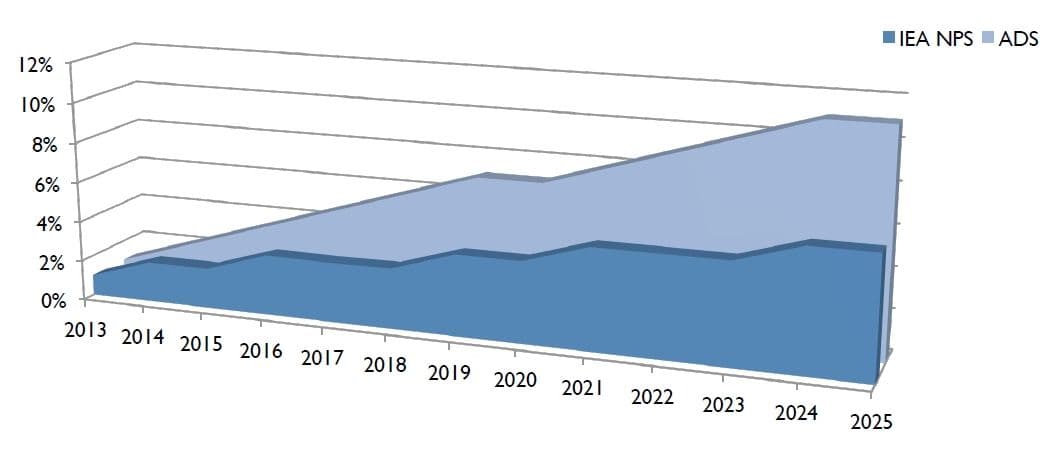
700 GW of new solar and wind power plants by 2040. That is, according to the International Energy Agency, the sum of the national action plans from Asia (excl China), Latin America and Africa submitted to the COP21 summit in Paris. In other words, IEA estimates it will take 25 years – in 2040 – for wind and solar to reach 9% of the total electricity power consumption in developing countries. I believe this is far too modest, and a wasted opportunity.
In a paper that I and Daniel Rossetto of Climate Mundial last week published in Environmental Finance, we ask the question: What would be the effects of doubling the deployment rate for wind and solar energy, and how much would it cost? Under our accelerated deployment scenario, instead of waiting until 2040 to build the 700GW, the investments are brought forward by 15 years to 2025. The key enabler is here the willingness of industrialized countries to commit to a higher level of ambitions for greenhouse gas reductions up to 2030 – and to allow for the use of markets to achieve those new climate goals in the most cost-efficient manner.
The results of the analysis are surprising.
First, the share of solar and wind in developing countries’ electricity-mix increases from less than 1 % today to 11% by 2025, compared to rather just 9% in 2040