Saving the planet with bioenergy, or not?

A bioenergy crop may be harvested and grown back within a year. In this case, bioenergy would be far better than coal almost instantly, writes Glen Peters.
Bioenergy uses biomass (wood, pellets, waste, bioenergy crops) to produce energy. Coal energy, uses coal to produce energy.
Neither coal nor bioenergy are environmentally benign.
A new report by Chatham House has come out strongly against bioenergy, with a rebuke from IEA Bioenergy, igniting a “fierce academic row”.
The Chatham House report notes that “in most circumstances, …, the use of woody biomass for energy will release higher levels of emissions than coal and considerably higher levels than gas”.
Is that true? Is the use of bioenergy, “in most circumstances”, worse than burning coal?
Let’s simplify the discussion, and assume we can only produce energy with coal or bioenergy. No, you can’t run and hide, and pick another energy carrier. The two choices are coal or bioenergy to produce energy. One or the other.
Think of it as case of “choosing the lesser of two evils”. Does coal or bioenergy cause less environmental harm?
The coal case is easy. You burn coal, CO2 that was buried in the ground for millions of years goes into the atmosphere and enters the carbon cycle. The carbon cycle distributes some of the emitted fossil CO2between the land and ocean sinks, but a portion of the emitted fossil CO2will remain in the atmosphere for ever and cause global warming. Fossil CO2is permanently taken from the ground into the atmosphere. Permanent.
Bioenergy is more complex. Biomass grows, with some help from an external energy source, the sun. There is a cycle. Harvest. Grow. Harvest. Grow. Harvest. Grow. The biogenic CO2cycles between the forest and the atmosphere. Think of it as like agriculture. Land is not used once. It is reused.
The fact that biomass can regrow is where the bioenergy debate gets messy. Suppose we didn’t regrow biomass after harvest. Suppose we chopped down a forest and covered the area with concrete. Then, bioenergy would, in fact, be worse than coal. Yes. True.
More realistically, the forest manager has some common sense. They don’t want their business to go broke after one harvest. They replace the harvested tree with a new tree, either by direct planting or viaseed trees. They may do it badly, they may do it slowly, they may require some government regulation, but let’s assume they do it.
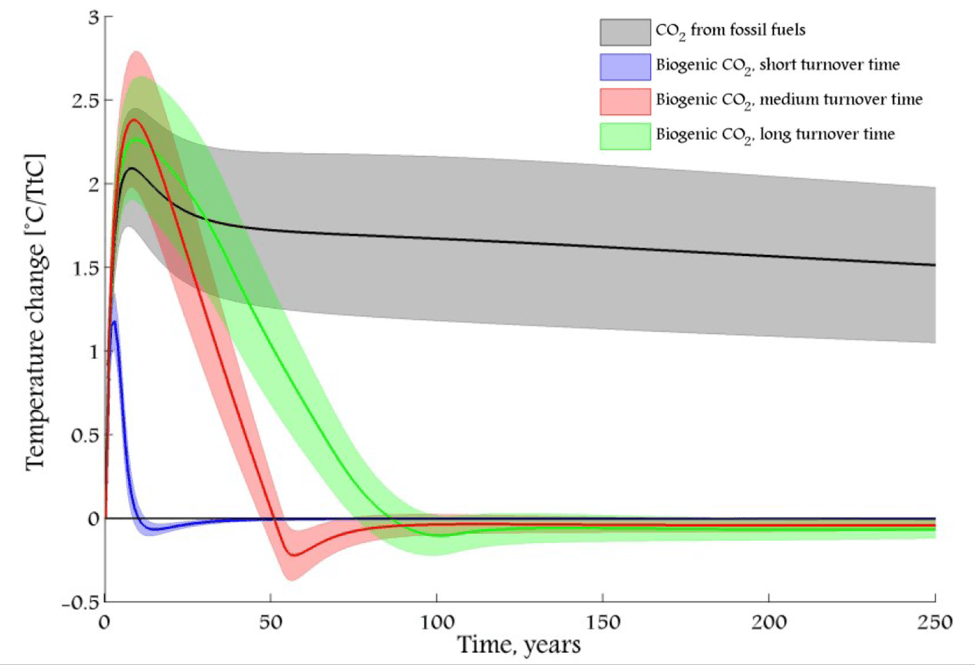
In a boreal area, the forest may take 100 years to grow back. Eventually, given a time lag, bioenergy would be better than coal.
A bioenergy crop may be harvested and grown back within a year. In this case, bioenergy would be far better than coal almost instantly.