Global coal consumption may have peaked, solar and wind have had explosive growth, yet global emissions remain flat. We have a way to go!
The UK is moving away from coal. Pictured here: the coal-powered Fiddler’s Ferry power station in northwest England and wind turbines on Frodsham Marsh in the foreground.
The BP energy statistics provide a comprehensive and updated view of global energy markets, and they are constantly improving the presentation and quality. For someone that works on emission statistics and emission trends, I certainly learn something new every year.
Most of the coverage has focused on the slowdown in global emissions growth, the explosive growth in renewables, or the unexpected decline in coal consumption. Carbon Brief has a detailed overview.
The slowdown in global emissions growth is great news and opens new perspectives on emission pathways going forward. But the real question, for me at least, is where are emissions going in the next decade?
Will emissions return to growth, plateau, or even decline? I think of this as a tug-of-war between countries pushing emissions up, and countries pulling emissions down. Who will win the battle?
Emissions flat for three years
It is worth remembering why emissions growth has stabilized. We tend to lose sight of a simple fact: emissions growth has slowed because of China.
The slowdown in global CO₂ emissions growth is overwhelmingly due to China #BPstatshttps://t.co/OZYrKQzBgj pic.twitter.com/xvRROkfsKN — Glen Peters (@Peters_Glen) June 20, 2017
And the massive turn around in China is due to reduced output for iron, steel, and cement, due to the end of the construction boom.
What happens when a construction boom ends?Less iron, steel, cement, coal, & CO₂.That is China! #BPstatshttps://t.co/OZYrKQzBgj pic.twitter.com/nu2ymgqgje — Glen Peters (@Peters_Glen) June 21, 2017
These changes are likely permanent, suggesting that Chinese emissions may have reached a plateau, or even peaked. Well, peaking requires emissions to trend down for some time and that hasn’t started…
The death of coal
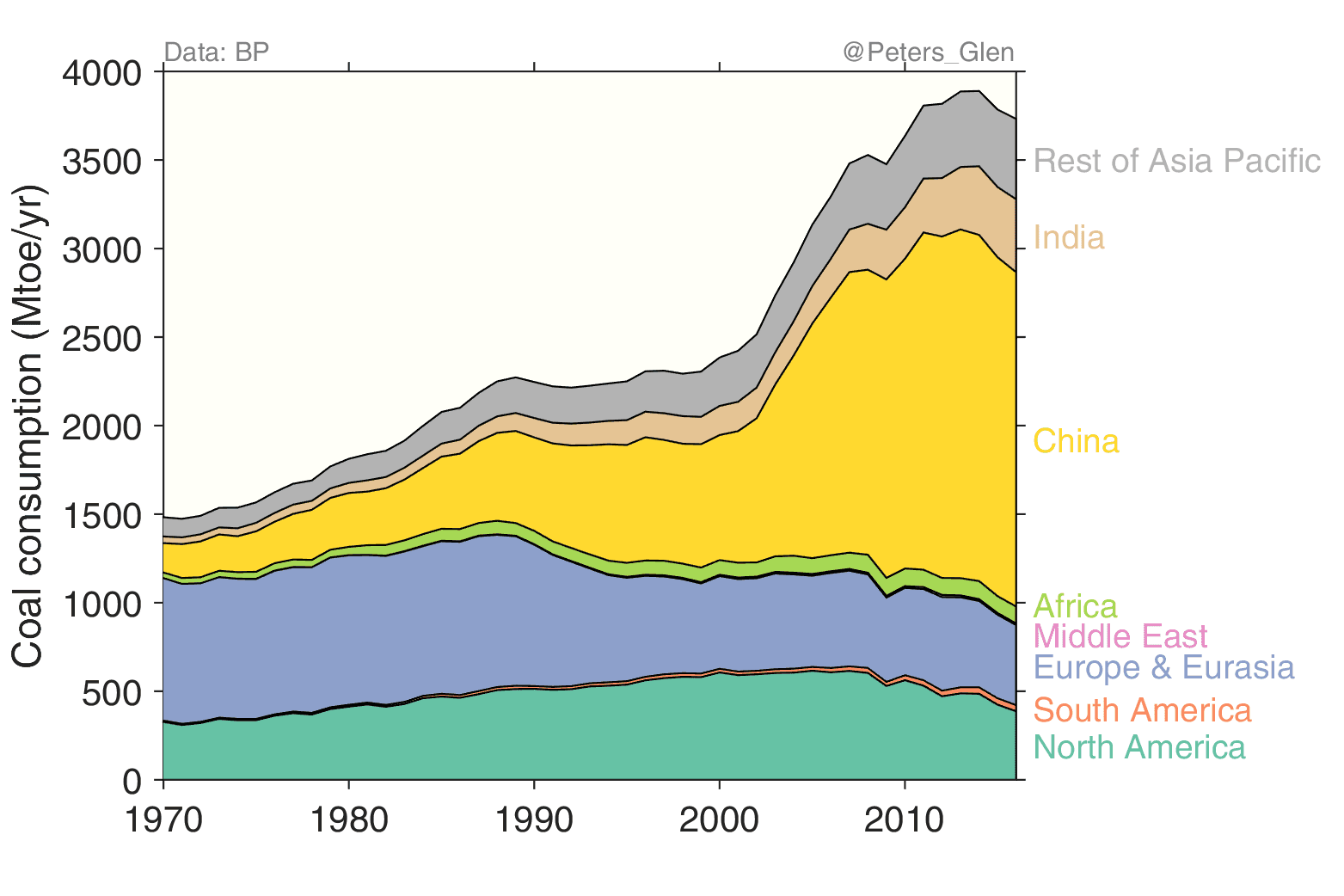
While all eyes have been on coal in China, and the US, the global picture for coal is rather bleak. Coal is in decline (almost) everywhere.
Has coal consumption peaked globally? Leading to a collapse as in the UK?
The decline in coal, begs the question. If coal consumption has gone down globally, and it is the most important fossil fuel, then why are emissions only flat globally?
Coal consumption is on the decline almost everywhere, with the only meaningful growth in India and South-East Asia.
Don’t forget that oil and gas are still growing, rapidl
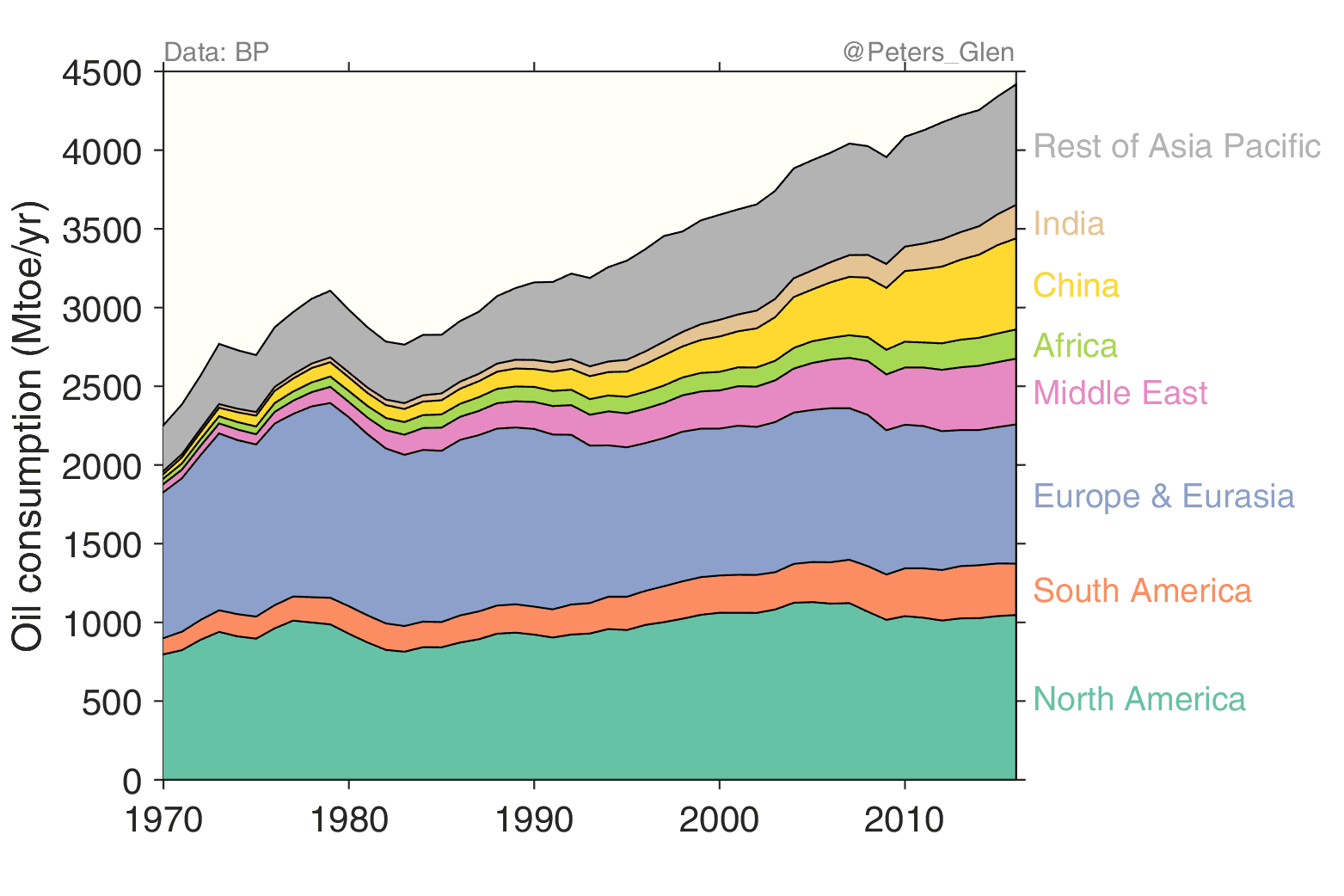
We forget about oil and gas, both of which are growing strongly. Oil consumption is perhaps flat in the OECD countries, but gas consumption is on the rise everywhere.
The decline in coal consumption is putting downward pressure on carbon dioxide emissions, but the radical reductions are only barely offsetting the strong push upwards from oil and gas. The tug-of-war, coal versus oil and gas.
A similar tug-of-war is playing out at the country level. Some key countries are pushing emissions down (China, US, EU28), but at the same time, other countries are pulling emissions up (India, Middle East, Africa).
Oil consumption has levelled out in the OECD countries, but continues to grow strongly in the non-OECD countries and globally.
Gas consumption is growing strongly almost everywhere.
Renewables are growing strongly, but from a low level
Renewables are growing fast and making a dent in global energy markets, but this is on the back of slow growth in energy consumption (and declines in coal).
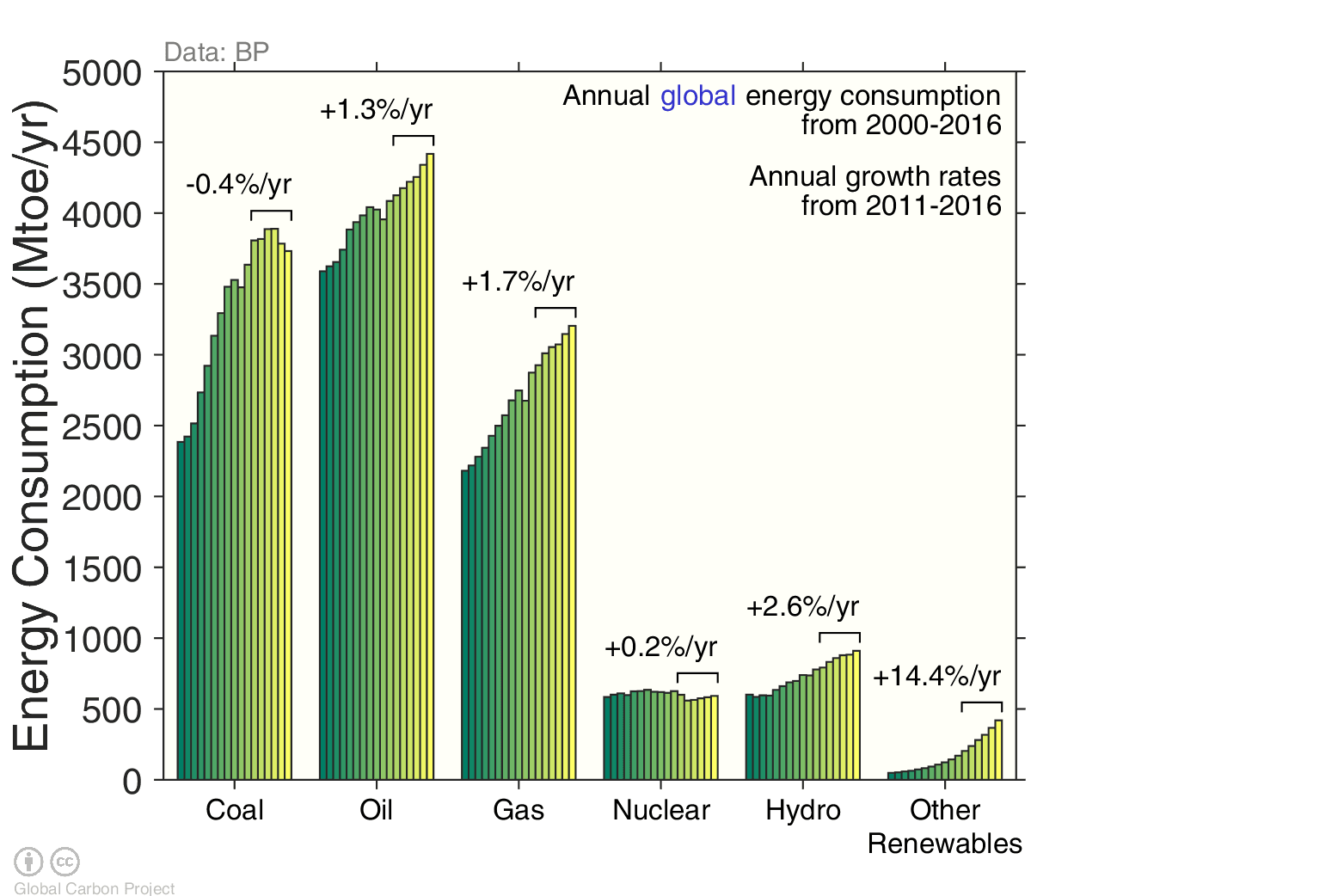
The world is throwing everything at renewables, but a 1% growth in coal, oil, or gas, is enough to drown out the impressive relative growth in renewables.
Coal might be dying, but fossil fuels are still king!
The global energy mix is still dominated by fossil fuels, despite rapid growth in renewables. BP scales up the actual energy use of nuclear, hydro, and other renewables by 0.38 to approximate the efficiency loss in fossil energy consumption and make the different energy sources comparable in terms of primary energy.
Who wins the tug-of-war?
Will declining emissions due to coal consumption offset the gains in oil and gas?
Will declining emissions in China and the US offset the gains in the rest of the world?
Will solar and wind, and other renewables, be sufficient to offset the gains in all fossil fuels?
If the answer to any of these questions is "no", then we are not winning the tug-of-war. Factors pulling emissions down are offset by factors pushing emissions up.
At best, the tug-of-war might keep emissions flat for some years, even decades.
A collapse in global coal consumption and explosive growth in renewables is only enough to keep emissions flat, which only indicates the immense challenge we face!
Coal may have peaked, solar/wind have arrived at the base of the mountain, but oil/gas are going like gangbusters...https://t.co/gPRg8txElU pic.twitter.com/PqAVqmEGzA — Glen Peters (@Peters_Glen) June 15, 2017