Electricity for all Africans is an important goal, but comes with a big risk: Increasing pollution and CO₂ emissions from back-up diesel generators. In order to avoid this crisis scenario, providing energy access for all must go hand in hand with investments in distributed renewables .
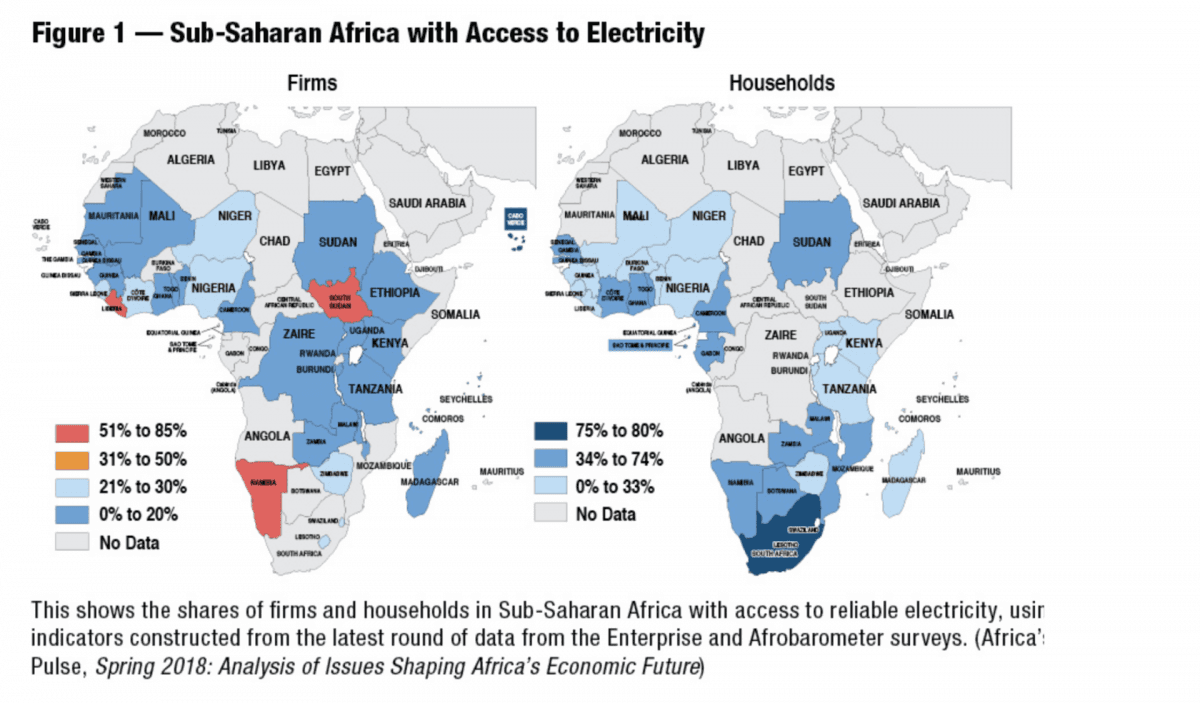
Shares of firms and households in sub-Saharan Africa with access to reliable electricity.
Debatt
Dette er et debattinnlegg. Teksten er kvalitetssikret i tråd med redaksjonelle prinsipper for publisering. Innholdet reflekterer skribentens egne meninger.
Over 120 million people worldwide gained access to electricity last year, according to new data from the International Energy Agency’s (IEA) World Energy Outlook 2018 . Also in Africa the electrification rate rose last year, now at 43%, but it has not kept pace with the continent’s growing population. Therefore, the number of people in Africa without access to electricity still stands at about 600 million.
Providing energy access for Africa’s unserved population is one of the most popular targets for development finance and so-called impact investors these days. That’s the message from a recent World Bank report on the topic, and is also my take-away from the Global Impact Investor Network – GIIN – Forum that took place in Paris end of October. But can the efforts to reach one of UNs Sustainable Development Goals (SDGs) – nr 7, Energy access for all – hurt the realisation of equally important development goals?
Shares of firms and households in sub-Saharan Africa with access to reliable electricity.
In principle, connecting the about 600 million in Sub-Saharan Africa currently without access to electricity can go hand in hand with addressing climate change and local pollution. A recent study for Netherlands Environmental Assessment Agency – Towards universal electricity access in Sub-Saharan Africa – estimates that USD 9–33 billion of additional investments per year are required to meet the universal access target by 2030. This includes investments in generation capacity, transmission and distribution. The additional investments to reach universal access would have only a negligible effect on climate mitigation. The study estimates – assuming current energy mix and generation plans – the additional yearly CO₂ emissions from achieving universal electricity access to be in the range of 5-10 million by 2030.
The study also sets out a renewable energy and energy efficiency scenario where the introduction and gradual increase of carbon tax "induces a reduction in the use of fossil fuels and a more rapid development of low carbon electricity generation technologies, including renewable energy. Furthermore, it stimulates energy savings in the form of improved appliance efficiency, resulting in decreased electricity demand". In this scenario, meeting the universal access target is achieved without increased CO₂ emissions.
However, I am afraid this and similar studies do not take due account of the realities on the ground. The daily experience for electricity users across Sub-Saharan Africa is still frequent power outages, resulting in accelerated reliance on back-up diesel generators, increasing local pollution and CO₂ emissions – a struggle that risk being further aggravated with increasing number of users.
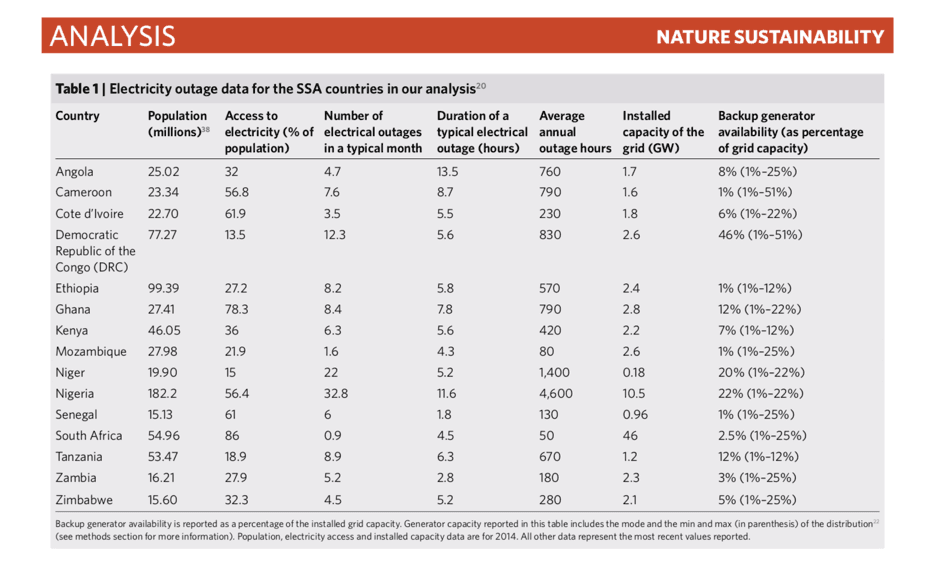
The magnitude of the challenge is well described in an article recently published in the journal Nature, "Sustainability implications of electricity outages in sub-Saharan Africa", by three researchers at the University of Pittsburgh, USA. The article shows that in Nigeria, Ghana, Tanzania, Angola, Kenya and most other countries in Sub-Saharan Africa emergency diesel generators represent grossly 10–20 percent of the country’s total power generating capacity. Between 500 and 1000 hours per year are typically lost in power outages, and even up to 5000 in Africa’s most populous and fast-growing country Nigeria. Users seek to mitigate the effect of power outages by increased use of diesel-generators. Power-outages therefore not only equal higher costs and lost revenues for businesses, and lost working time for students, health workers and others. It also translates into tens of thousands of infant deaths: Diesel generators is a main source of local particular pollution, estimated to have led to an additional 449,000 infant deaths in 2015 in Sub-Saharan Africa.
The rest of Africa is still far behind Nigeria in diesel generator usage, but that can change as countries like the Democratic Republic of Congo, Tanzania, Kenya, Angola, Ethiopia a.o. seek to expand energy access and countries like Ghana seek to boost electricity usage. A doubling of energy access in Sub-Saharan Africa combined with a 3-fold growth in the of average electricity usage would, given current outage pattern, lead to additional CO₂ emissions from diesel generators in the range of 10 million tons or more. This increase would then come in addition to the growth in emissions from the national generation sector projected above.
Electricity outage data for countries in sub-Saharan Africa.
The conventional answer to this challenge has been to invest heavily in large centralised power plants, and seek to build high-voltage transmission lines to bring the power from the generators to the population and economic senters. Such investments will still be needed many years to come, but the experience shows that it takes too much time – and is too expensive – to rely mainly on centralised generation and transmission to meet the fast-growing demand from businesses and households in Africa. Distributed renewable generation – ie generation closer to the user and often behind the users’ meter – can solve the problem of power outages quicker, cleaner and most often to a lower cost than the alternatives. Small and medium sized solar PV or run of river hydro plants directly connected to the medium-voltage network furthermore help stabilise the voltage level and reduce losses, a benefit that can be further enhanced by adding features like reactive power and short-term storage capacity.
The current high and growing dependency on diesel back-up generation in Africa should not be seen as a temporary phenomenon, but rather a serious warning signal of what is to come. In order to avoid this crisis scenario, providing energy access for all must go hand in hand with investments in the countries’ generation and distribution capacity. Accelerated deployment of distributed renewables is not the whole answer, but an important part of it.