2

Støtt oss
Stillinger
2
Klimakalender

Om oss

Om oss
Støtt vårt arbeid
Annonsere
Personvernerklæring
Administrer informasjonskapsler

Følg oss

Facebook
Bluesky
Linkedin
Rss feed

Kontakt oss

Redaksjonen
Energi og Klima
Odd Frantzens plass 5
N-5008 Bergen
til toppen
Terje Osmundsen
Terje Osmundsen
Grunnlegger og adm. dir. Empower New Energy. Investor og styremedlem innen fornybar energi.
Publisert 20. juni 2016
Artikkelen er mer enn to år gammel
Debatt

On the verge of amazing growth in solar and batte­ries – but still far behind 2°C trajec­tory

Impressive as it is, the colossal growth in renewables projected by Bloomberg is still far from sufficient to keep global warming below 2°C.

pv_tak_massachusetts_

More PV panels are being mounted – but still more are needed.

Publisert 20. juni 2016
Sist oppdatert 15.9.2025, 15:29
Artikkelen er mer enn to år gammel
Terje Osmundsen
Terje Osmundsen
Grunnlegger og adm. dir. Empower New Energy. Investor og styremedlem innen fornybar energi.

«New Energy Outlook 2016» (NEO 2016), the yearly flagship publication from Bloomberg’s 65 new energy experts from around the world published mid-June, is fascinating reading. Despite cheaper coal and cheaper gas, wind and solar are now the leading sources of new generation capacity added worldwide. By 2040, hydro, wind, solar and batteries will make up 60% of installed capacity, projects Bloomberg New Energy Finance. Wind and solar will account for 64% of the 8.6TW of new power generating capacity added worldwide over the next 25 years.

This strong growth, says Bloomberg, will be driven mainly by economics. In fact, most countries will have phased out subsidies to renewable energy by 2020. But impressive as it is, this projected colossal growth in renewables is still far from sufficient to what’s required to meet the 2°C trajectory. A 50 % additional increase in green energy investments will be needed.
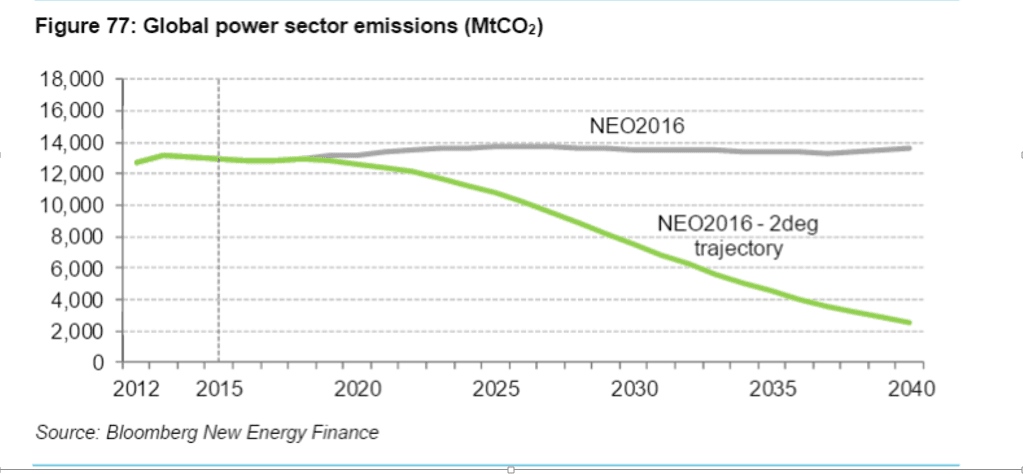
Totale klimagassutslipp fra kraftsektoren (kilde: Bloomberg New Energy Finance)
Global power sector emissions (Source: Bloomberg New Energy Finance)

The main driving force behind the growth is wind and in particular solar keep getting cheaper. By 2030, solar power will have emerged as the cheapest generation technology in most countries. By around 2027, Bloomberg estimates it will even be more economic to build new wind and solar than running existing coal and gas generators, particularly where carbon pricing is in place. Another factor reinforcing decarbonisation is electrification of the transport sector, mainly driven by continuous decline in cost of batteries. NEO 2016 projects electric vehicles will make up 25% of the global car fleet by 2040.

RenewEconomy
This blog post has also been published by Australian website RenewEconomy.

It is also interesting to note that natural gas, in Bloomberg’s analysis, does not succeed to become a key ‘transitional fuel’ between coal and renewables. In fact, natural gas’ share of the world total installed generation capacity drops from 26 to 16 % between 2015 and 2040. Its share of total global generation, however, increases from 9 to 16 %. This is because natural gas plants have higher capacity factors than the intermittent sources wind and solar. But despite the higher capacity factor, Bloomberg projects that by 2040 the world’s solar plants will generate 100 % more electricity than all the world’s natural gas plants.
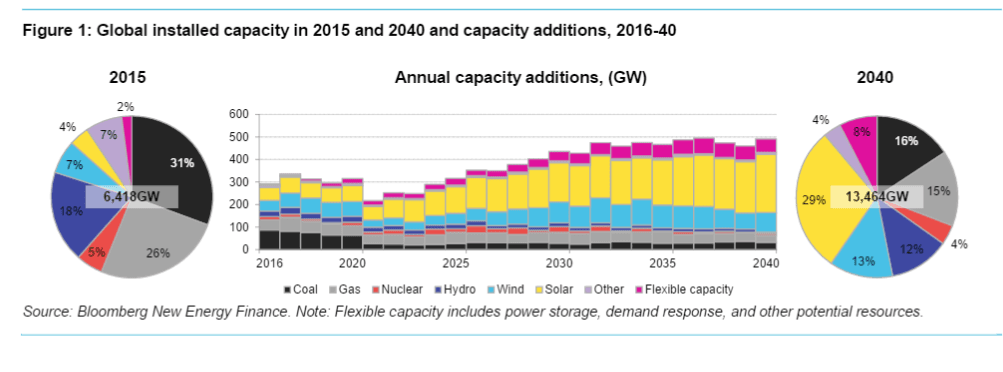
Global installert kapasitet i 2015 og prognose for 2040, samt for hva slags kraftproduksjon økningen vil komme (kilde: Bloomberg New Energy Finance)
Global installed power capacity in 2015 and projections for 2040, including projections for capacity additions (Source: Bloomberg New Energy Finance)
Artikkelen fortsetter under annonsen


The main message to be read from Bloomberg’s latest report, however, is a more sober one. As the energy sector make up two-thirds of global greenhouse gas emissions, the target to stabilize and reduce carbon emissions will require a deep decarbonisation of the power systems. By 2040, Bloomberg expects the energy intensity of the world economy to fall by 28% and its carbon intensity by 50%. China will see the greatest reduction of both carbon and electricity intensity in absolute terms.

But despite this significant progress, we’re still far behind what is needed to meet the 2°C trajectory, warns Bloomberg. If we want to follow the trajectory leading to 50 % chance of keeping the global warming below 2°C, Bloomberg estimates that «around 10TW of zero-carbon power generation will need to be installed by 2040, representing a $14.6 trillion investment opportunity over the next 25 years». This is 56% more new capacity than under the NEO 2016 forecast which anticipates the need for $9.3 trillion of new zero-carbon investment, or around $373 billion per year. This means that yearly investments in zero-carbon technologies must increase from about 373 billion in Bloomberg’s «un-subsidized» scenario, to about 560 billion average per year in a climate-resilient scenario.

190 billion USD yearly in «additional» investments is a huge amount, but the costs of postponing these investments are much higher. Fortunately, the private sector is ready to develop and finance the required accelerated investments in renewables, storage, etc. What governments need to assure, through the new Green Climate Fund or finance institutions already involved in green energy financing, is the availability of guarantees, low-interest loans or other instruments that will make clean energy an attractive alternative when competing against new coal-fired plants in Asia and Africa. «New Energy Outlook 2016» is a timely reminder of the need to move forward on the pledge in Paris to allocate 100 Billion USD yearly in new climate finance to the developing countries, where most of these investments will need to take place.

ANNONSE
Bluesky

Les også

Et panel av internasjonale delegater sitter ved et konferansebord under en skjerm som viser "Thematic Session 2: The Energy Transition", med vindturbiner i bakgrunnen.

Ti år etter Paris: Klimamålene glipper, men mulighetene vokser

Klimatoppmøtet i Brasil trenger ikke nye avtaler, men en raskere gjennomføring av de avtalene vi allerede er blitt enige om, skriver Sverre Alvik i DNV.

11. november 2025
Les mer
Et skip merket "CO2 CARRIER" ligger til kai ved et industrianlegg med høye lagertanker og skogkledde landområder i bakgrunnen under en klar blå himmel.

Gladmelding om CCS

Det globale potensialet for lagring av CO₂ er ikke ubegrenset, ifølge ny studie. Men potensialet er fortsatt mer enn stort nok, skriver Tore Killingland.

29. september 2025
Les mer
Nærbilde av et tak under konstruksjon med svarte soltakshingel delvis montert ved siden av eksponert treverk.

Lønnsomhet for private solceller med Norgespris

Endringer i nettleien kan gjøre solceller på hustak lønnsomt – selv med Norgespris på strøm, skriver professor Erling Moxnes.

19. august 2025
Les mer
Luftfoto av en motorvei med biler som kjører gjennom et grønt skogsområde på en solrik dag.

I teknokratenes tid er alle mål dyre

Bruken av økonomiske likevektsmodeller har blitt til fasiten på hva som er en god politisk beslutning, selv om de ikke løser noen av spørsmålene vi trenger svar på, skriver Ingrid Lomelde.

19. august 2025
Les mer
ANNONSE