1

Støtt oss
Stillinger
1
Klimakalender

Om oss

Om oss
Støtt vårt arbeid
Annonsere
Personvernerklæring
Administrer informasjonskapsler

Følg oss

Facebook
Bluesky
Linkedin
Rss feed

Kontakt oss

Redaksjonen
Energi og Klima
Odd Frantzens plass 5
N-5008 Bergen
til toppen
Terje Osmundsen
Terje Osmundsen
Grunnlegger og adm. dir. Empower New Energy. Investor og styremedlem innen fornybar energi.
Publisert 22. november 2018
Sist oppdatert 16.9.2025, 00:09
Artikkelen er mer enn to år gammel
Debatt

Renew­ables losing market share in Africa

Alarming new data reveals coal, liquid fuels, gas strengthening grip on Africa’s power sector. Investments in renewables too slow to keep pace with demand growth.

vind_marokko

Wind is growing in Africa, but not fast enough to keep up with fossil fuel growth. Photo from Tarfaya wind power project in Morocco.

Publisert 22. november 2018
Sist oppdatert 16.9.2025, 00:09
Artikkelen er mer enn to år gammel
Terje Osmundsen
Terje Osmundsen
Grunnlegger og adm. dir. Empower New Energy. Investor og styremedlem innen fornybar energi.

Despite all the talk of making Africa greener, the share of renewables in Africa’s power production actually dropped in the period from September 2017 to September 2018. These alarming data was presented at the launch of the 2018 «African Energy Data Book», at the occasion of the Africa Investment Exchange in London November 15.

According to the same publication, the proportion of renewable energy in the generation mix has declined so far in 2018 in all regions except Central Africa. Despite a slight increase in the overall share of wind and solar in three of the five regions, the slow growth in hydro combined with sustained growth in all forms of hydrocarbons resulted in an overall increase in the share of plants running on hydrocarbons and a corresponding reduction in the shares of renewables.
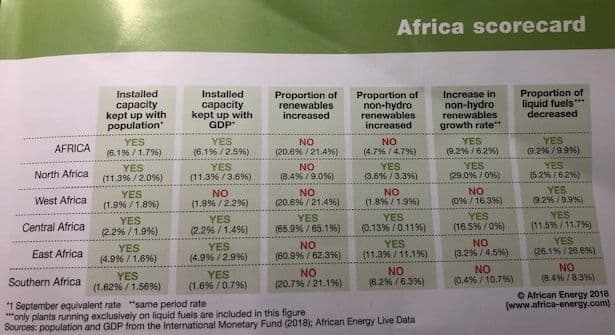
The proportion of renewables in the power sector fell in 2018 in all African regions except Central Africa. (Source: African Energy – africa-energy.com)

The use of both the two most polluting sources of power production, coal and liquid fuels, are still growing in Africa. Since 2010, coal power has increased its installed capacity in Africa by 13%, and is expected to peak in 2022 at 60 GW. Perhaps more surprising is the increased reliance on liquid fuels – diesel, HFO (High Sulphur Oil) and other fuels – in the power sector. Overall, the share of plants running exclusively on liquid fuels rose from 8,6% to 19% in 2018. In addition, a large share of the dual gas/liquids-powered plants built in Africa are running on liquids as well.

In reality, the dominance of fossil fuels in Africa’s electricity generation is higher than accounted for here. This is because the African Energy Live Data does not include the so-called «Emergency power» segment, i.e the millions of distributed diesel gensets (generators) feeding directly into large and small energy users across Africa. Emergency power from diesel generators typically counts for 10–20 percent the total generating capacity in Sub-Saharan Africa, according to a recent study cited in my blog – «Energy access for all» – a double-edged sword?. In Nigeria alone, it is estimated that the county’s 9 million generators emit 19 million tons CO₂ per year, equal to the emissions from 4–5 average-sized coal power plants.

The growing dependence on fossil fuels in power generation, highlights the urgent need to accelerate investments in renewables across the continent. But experience shows that the conventional strategy of mainly relying on centralized power plants combined with high-voltage transmission to the population and economic centers take far too many years to implement and often become more expensive than originally anticipated. Distributed renewable generation – i.e generation closer to the user and often behind the user’s meter – can bring affordable power to Africa’s users quicker and to a lower cost than the alternatives.

ANNONSE
Bluesky

Les også

Industrielt raffinerikompleks med flere blå lagertanker, destillasjonstårn og rørledninger under en overskyet himmel.

Kan Europa greie seg uten norsk gass?

Det trengs beredskap når sola og vinden svikter, det kan ta tid og bli dyrt å bygge nok kraftledninger til Europas elektrifisering. Inntil videre bør vi derfor produsere norsk gass, mener Gerard Doorman.

2. desember 2025
Les mer
En moderne industribygning med flere lasteramper og to høye skorsteiner som sender ut hvit røyk under en overskyet himmel.

Derfor bør CO2 fanges fra avfallsforbrenning

Flere norske byer bør gjøre som Oslo nå gjør på Klemetsrud. Deriblant Trondheim, der hvert fjerde tonn med fossilt CO₂ stammer fra avfallsforbrenning, skriver fire Sintef-medarbeidere.

26. november 2025
Les mer
Forretningsbygg med solceller på taket sett ovenfra.

Stort potensial for grønne investeringer i Afrikas mest folkerike land

Norsk kompetanse og investeringer er gull verdt når Nigeria skal legge om til et grønt lavutslippssamfunn. Samtidig har vi mye å vinne på å handle med Nigeria, skriver Terje Osmundsen og Solveig Tangen.

24. oktober 2025
Les mer
Flere høyspentledninger og master strekker seg over et landlig landskap med åser i bakgrunnen under en overskyet himmel.

Vi behøver ikke ofre landskap og natur for å få mer kraft

Det finnes energitekniske løsninger som kan dekke det økende strømbehovet til næring og industri uten at vi må ofre landskap og natur, skriver Usman Dar og Karen Holst fra Asplan Viak.

8. oktober 2025
Les mer
ANNONSE